3-93
2.21 SLEWING OPERATION
• Check the safety around and honk the horn before slewing.
• Operate the slewing lever as slowly as possible.
Start smoothly, slew at low speed, and stop gently.
Sudden lever operation especially while hoisting a load
will cause the load to swing, causing the loss of stability
in the machine, and thus may break the crane or overturn
the machine.
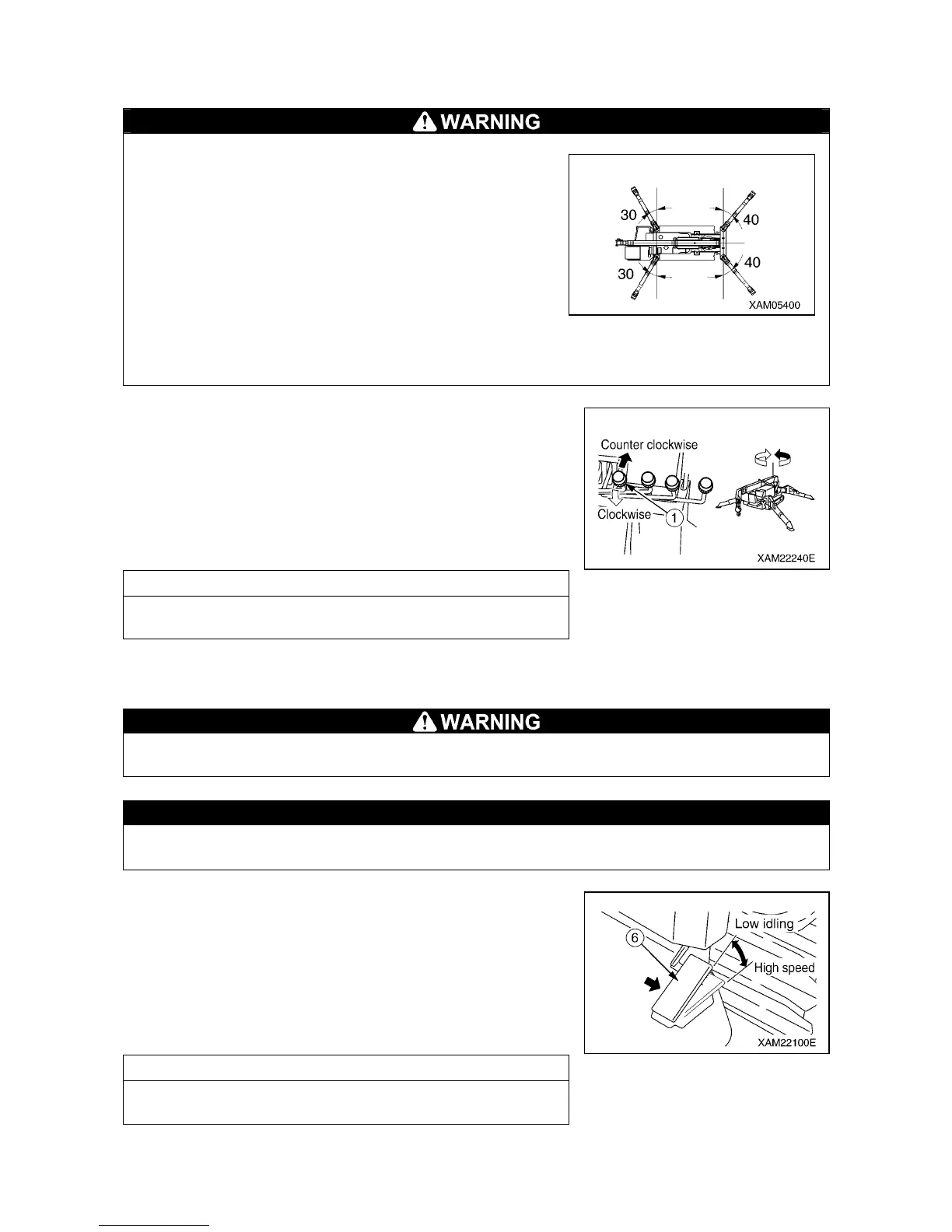
• Even if the outriggers are set normally, some directions
have lower stability when slewed for 360 degrees. Be
extremely careful when slewing while hoisting a load.
• Depending on how outriggers are extended, the hoisted
load may hit an outrigger during the slewing operation,
breaking the crane or overturning the machine. Be
careful not to let the hoisted load hit an outrigger.
Operate the slewing lever (1) as follows.
• Slew counter clockwise: Push the lever forward to the “LEFT”
side.
• Neutral: Release your hand from the lever.
The lever returns to the “NEUTRAL” position and the
slewing stops.
• Slew clockwise: Pull the lever toward you to the “RIGHT” side.
NOTES
Adjust the crane slewing speed with the slewing lever and the
stroke of the acceleration pedal.
2.22 ACCELERATION OPERATION
Accelerating the operation speed of the crane units more than is necessary is dangerous.
CAUTION
Decrease the speed in the beginning or near the end of an operation. Change the speed to low
speed or high speed according to the load.
Operate the acceleration pedal (6) as follows.
• Low idling: Release your foot from the pedal.
The engine speed decreases and the operation speed
of the crane units slows down.
• Full speed: Fully step on the pedal.
The engine speed increases, and the operation speed
of the crane units accelerates.
NOTES
Step on the pedal to the position of the engine speed necessary
for the task.


 To Next Page