4-40
[3] OIL REPLACEMENT IN HYDRAULIC OIL TANK
• All the parts will be at elevated temperatures immediately after engine operation, which urges
you not to replace oil. Always perform replacement with the oil cold.
• Potential gush of oil may occur upon removing the filler cap of the hydraulic oil tank.
Be sure to relieve internal pressure by slowly rotating the filler cap before cap removal.
• Make sure the filler cap is closed properly after replenishment of the oil.
Potential fall of the filler cap during operation may occur if disregarded, which could cause
boiling oil to gush that results in burns.
CAUTION
• See “Maintenance 5.1 Use of Lubricating Oil According to Temperature” for which oil to be
used.
• Place the machine in travel position for oil quantity inspection. Oil quantity inspection with the
machine in working position may deceive your eyes to deem the quantity of oil low. Owing to
improper judgment, the oil may be supplied at excessive amount.
• The engine must be at halt until piping and hydraulic equipment is filled with oil after
replacement of the hydraulic oil filter.
• Oil replenished should remain below “H” (upper limit) on the level gauge. Excessive oil
replenishment may cause the oil to gush from the air breather during machine traveling and
crane operation, which could result in burns.
• Keep impurities out of the filler cap when replenishing oil.
• Oil drain pan: An 70-liter container
• Quantity of oil for replacement: 55L
1. Place the machine on a level surface.
2. See “Operation 2.14 Outrigger Setting Operation” to rotate the
rotary of the all outriggers outward.
NOTES
Raise the machine slightly with the outriggers placed.
3. See “Operation 2.19 Boom Derricking Operation” to raise the
boom to a position where facilitated work is assured, and stop
the engine.
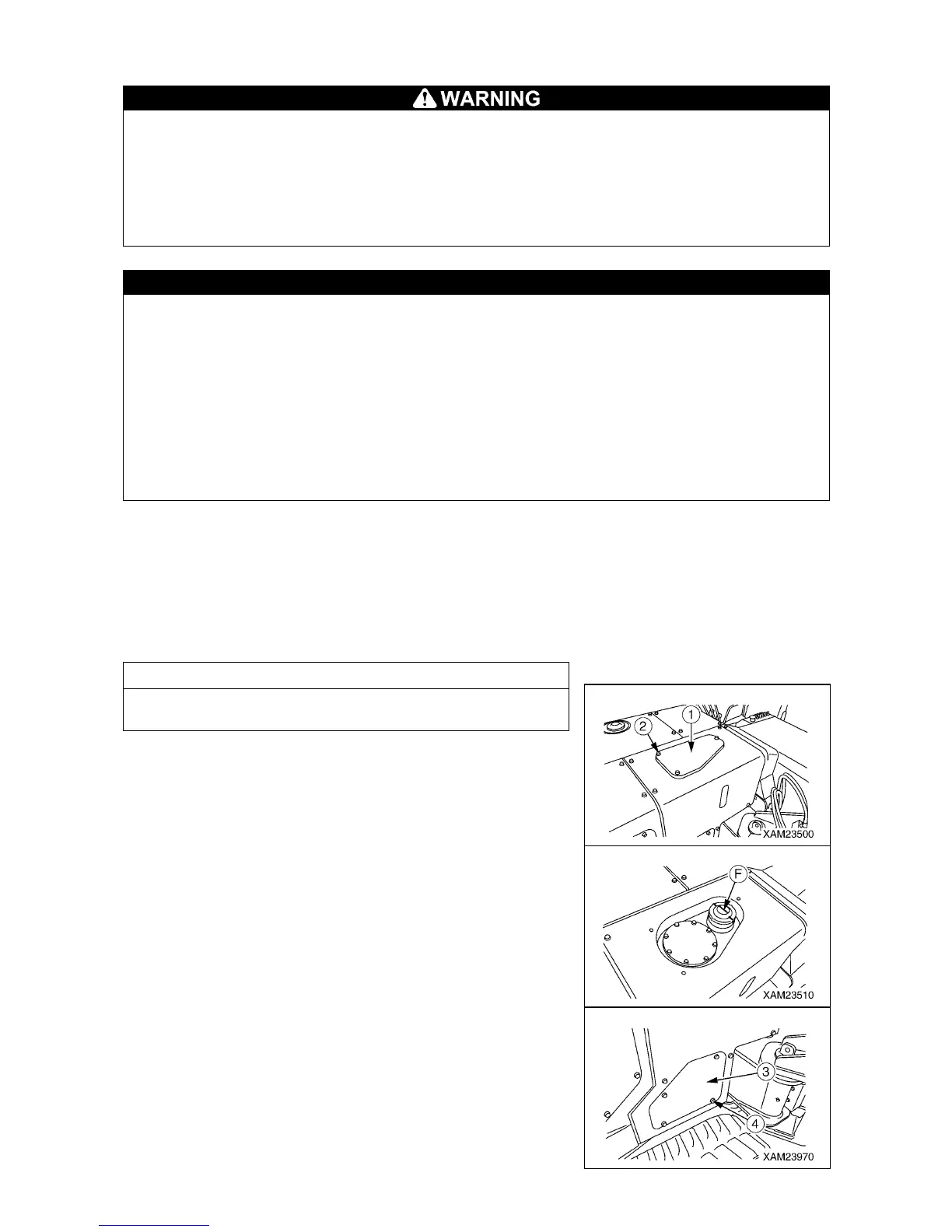
4. Remove the three mounting bolts (2) and remove the inspection
cover (1).
5. Remove the filler cap (F) located on top of the hydraulic oil
tank.
6. Remove the four mounting bolts (4) and remove the inspection
cover (3).


 To Next Page