Safety and Compliance Information
28
OM-296747A | 4/15/24
2.2.3 Laser Classification
Governmental standards require that all lasers be classified according to their
output power or energy and the laser wavelength. This device is classified as a high
power laser instrument with laser classification for each laser type identified in
Table 3 [▶28].
IMPORTANT
This product emits two types of laser radiation output
Primary Laser
: This is the material processing laser (Class 4, high power fiber
laser) which is used for welding (or cleaning). The emitted laser output is INVIS-
IBLE.
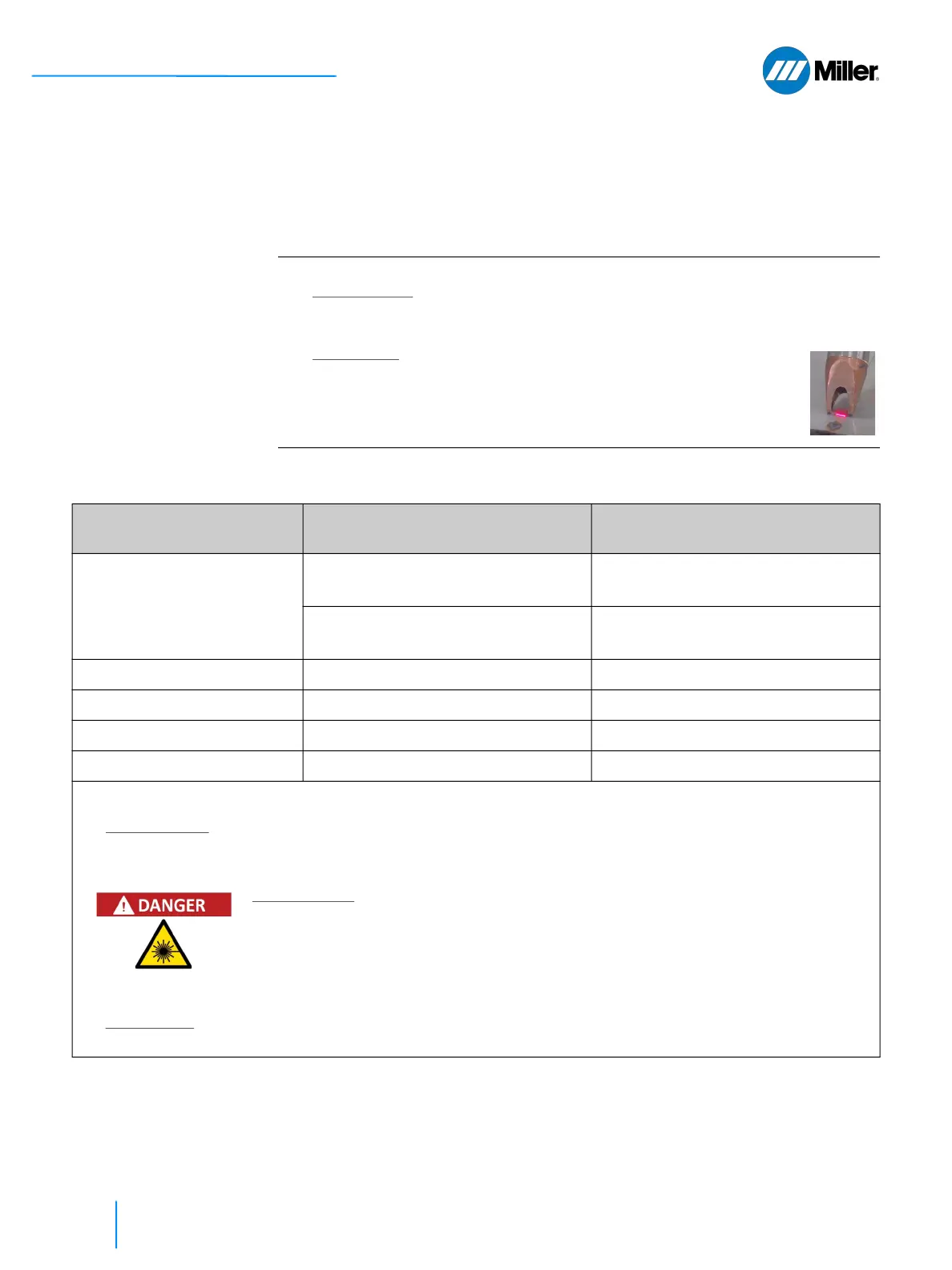
Guide Laser
: The guide laser (Class 2M) emits a VISIBLE red output
beam that is used by the Operator as a visual aid when positioning
the laser torch nozzle onto the parts prior to starting the welding (or
cleaning) process. Picture on the right shows the red guide beam
over the seam of the two plates prior to welding.
▼Table 3. Laser Classification Information
Characteristic Primary Laser
3
fiber laser used for welding/cleaning
Guide Laser
4
aids in positioning laser torch nozzle
Laser Classification
European Union
United States
Class 4 (per EN 60825-1) Class 2M (per EN 60825-1)
Class IV - (i.e. Class 4)
1
(per 21 CFR, Subchapter J, part II, 1040.10(d) )
Class II - (i.e. Class 2)
1
(per 21 CFR, 1040.10(g) )
Wavelength 1070 nm 600 to 700 nm
Laser Radiation Emitted INVISIBLE (IR) VISIBLE (Red)
Average Power
2
greater than 2000 W 1 mW
Peak Power
2
greater than 3000 W 1 mW
1
US laser classification uses roman numerals (i.e. IV = 4, and II = 2).
2
Primary Laser: Total light power radiated from the optical output is greater than 2000 W average and
greater than 3000 W peak per optical output port, depending on the model. Please refer to the product
specification for the specific performance characteristics of your device.
3
Primary Laser: Class 4 high power lasers present the most serious of all laser hazards.
Diffuse and specular beam reflections can inflict severe retina and/or cornea
injuries leading to severe and permanent eye damage. Class 4 laser beams are
also a potential skin hazard and fire hazard as well. Take precautions to prevent
accidental exposure to both direct and reflected beams and also against diffusely
scattered radiation.
4
Guide Laser: Eye exposure should be avoided. Do not stare into beam or view directly with optical
instruments.



 To Next Page