Important Safety Information (cont.)
4
OM-296747A | 4/15/24
Important Safety Information (cont.)
Everyone in Laser Controlled Area* Must Read and Observe
All users must review the Owner’s Manual in its entirety and be fully
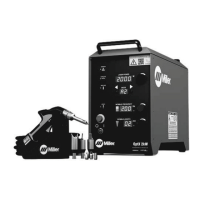
trained before using the OptX 2kW System
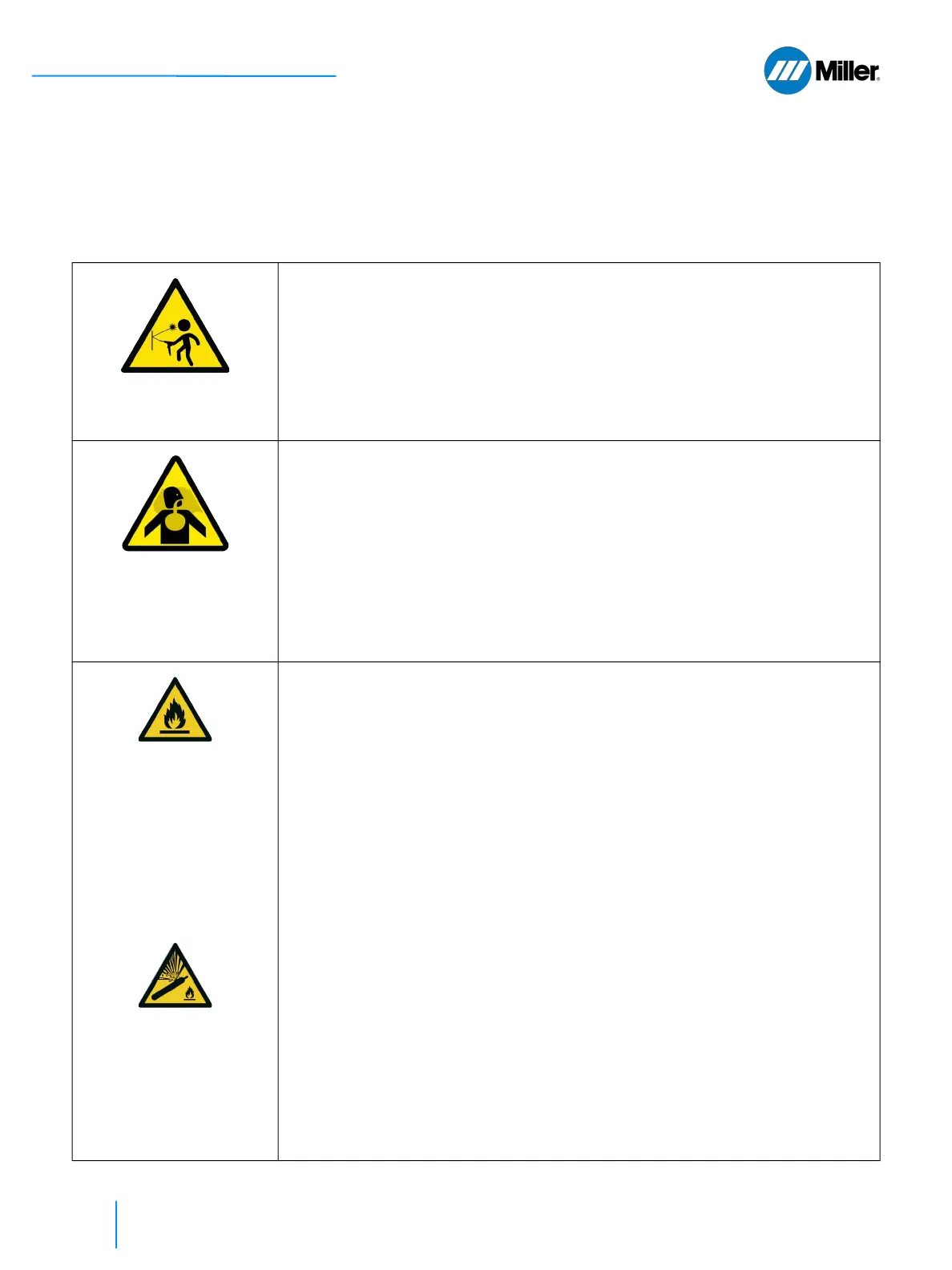
Reflected Beam Hazard
Highly reflective metals such as aluminum, stainless steel, copper and copper alloys can
cause reflection of the laser energy away from the target weld site to the laser source or
surrounding area and can present a hazard. Stray reflections can also damage materials,
components or equipment nearby to the laser processing area.
All persons in the Laser Controlled Area must wear all appropriate personal protective
equipment (PPE), including laser safety glasses, protective welding helmet, laser and heat
resistant gloves, caps, suits, leather apron and other laser and heat-resistant clothing, to
protect against eye damage from any reflected or scattered laser beams as well as welding
bright light, ultraviolet (UV) light, heat and sparks. Sleeves and collars should be buttoned
at all times.
Fume Hazards
Welding fumes from interaction of the laser beam with target materials can be comprised
of very fine particles. FUMES AND GASES can be hazardous. Welding produces fumes and
gases. Breathing these fumes and gases can be hazardous to your health. Keep your head
out of the fumes. Do not breathe the fumes. Ventilate the work area and/or use local forced
ventilation at the arc to remove welding fumes and gases. The recommended way to
determine adequate ventilation is to sample for the composition and quantity of fumes
and gases to which personnel are exposed. If ventilation is poor, wear an approved air-
supplied respirator. Read and understand the Safety Data Sheets (SDSs) and the
manufacturer’s instructions for adhesives, coatings, cleaners, consumables, coolants,
degreasers, fluxes, and metals.
During welding, always keep your head away from fumes. Always weld in an area
with adequate ventilation and use a fume extraction system to remove vapors,
particles, and hazardous debris from the welding processing area.
Other Hazards
Laser radiation (both reflected and scattered), and heat and sparks produced during laser
material processing can start a fire or cause an explosion in combustible or flammable
materials in the Laser Controlled Area.
Laser welding and cleaning must only be performed in an area free of combustible
or flammable materials. Never weld or clean parts on containers that have flammable
or combustible material. WELDING can cause fire or explosion. Welding on closed
containers, such as tanks, drums, or pipes, can cause them to blow up. Sparks can fly off
from the welding arc. The flying sparks, hot workpiece, and hot equipment can cause fires
and burns. Accidental contact of electrode to metal objects can cause sparks, explosion,
overheating, or fire. Check and be sure the area is safe before doing any welding. Remove
all flammables within 35 ft (10.7 m) of the welding arc. If this is not possible, tightly cover
them with approved covers. Do not weld where flying sparks can strike flammable
material. Protect yourself and others from flying sparks and hot metal. Be alert that
welding sparks and hot materials from welding can easily go through small cracks and
openings to adjacent areas. Watch for fire, and keep a fire extinguisher nearby. Beware
that welding on a ceiling, floor, bulkhead, or partition can cause fire on the hidden side.
CYLINDERS can explode if damaged. Compressed gas cylinders contain gas under high
pressure. If damaged, a cylinder can explode. Since gas cylinders are normally part of the
welding process, be sure to treat them carefully. Protect compressed gas cylinders from
excessive heat, mechanical shocks, physical damage, slag, open flames, sparks, and arcs.
Install cylinders in an upright position by securing to a stationary support or cylinder rack
to prevent falling or tipping. Keep cylinders away from any welding or other electrical
circuits. Never drape a welding torch over a gas cylinder. Never allow a welding electrode
to touch any cylinder. Never weld on a pressurized cylinder—explosion will result. Use only
correct compressed gas cylinders, regulators, hoses, and fittings designed for the specific
application; maintain them and associated parts in good condition. Turn face away from
valve outlet when opening cylinder valve. Do not stand in front of or behind the regulator
when opening the valve. Keep protective cap in place over valve except when cylinder is
in use or connected for use. Read and follow instructions on compressed gas cylinders,
associated equipment, and Compressed Gas Association (CGA) publication P-1 listed in
Safety Standards.



 To Next Page