Date Code 990430 Loss-of-Potential, Load Encroachment, and Directional Element Logic 4-3
SEL-351P Manual Técnico
L
OAD
-E
NCROACHMENT
L
OGIC
The load-encroachment logic (see Figure SECTION 4: .2) and settings are enabled/disabled with
setting ELOAD (= Y or N).The load-encroachment feature allows phase overcurrent elements to
be set independent of load levels. This is especially helpful in bus overcurrent applications. A
bus relay sees the cumulative currents of all the feeders, but still has to provide overcurrent
backup protection for all these feeders. If the phase elements in the bus relay are set to provide
adequate backup, they often are set close to maximum bus load current levels. This runs the risk
of tripping on bus load current. The load-encroachment feature prevents this from happening, as
shown in the example that follows in this subsection.
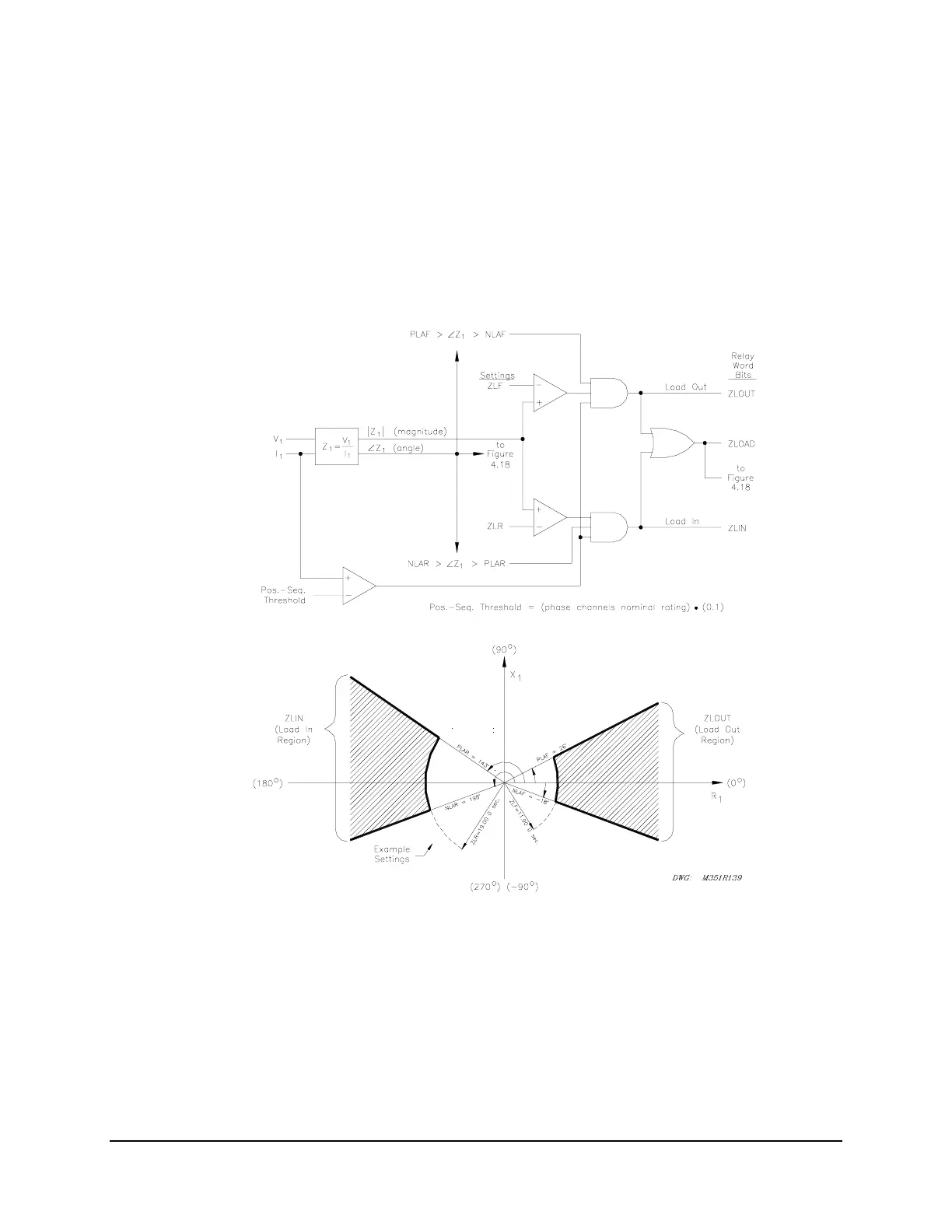
Figure SECTION 4: .2: Load-Encroachment Logic
Note that a positive-sequence impedance calculation (Z
1
) is made in the load-encroachment logic
in
Figure SECTION 4: .2. Load is largely a balanced condition, so apparent positive-sequence
impedance is a good load measure. The load-encroachment logic only operates if the positive-
sequence current (I
1
) is greater than the Positive-Sequence Threshold defined in
Figure SECTION 4: .2. For a balanced load condition, I
1
= phase current magnitude.
Forward load (load flowing out) lies within the hatched region labeled ZLOUT. Relay Word bit
ZLOUT asserts to logical 1 when the load lies within this hatched region.



 To Next Page