Date Code 990215 Breaker/Recloser Monitor, Battery System Monitor, 8-23
Metering, and Load Profile Functions
SEL-351P Manual Técnico
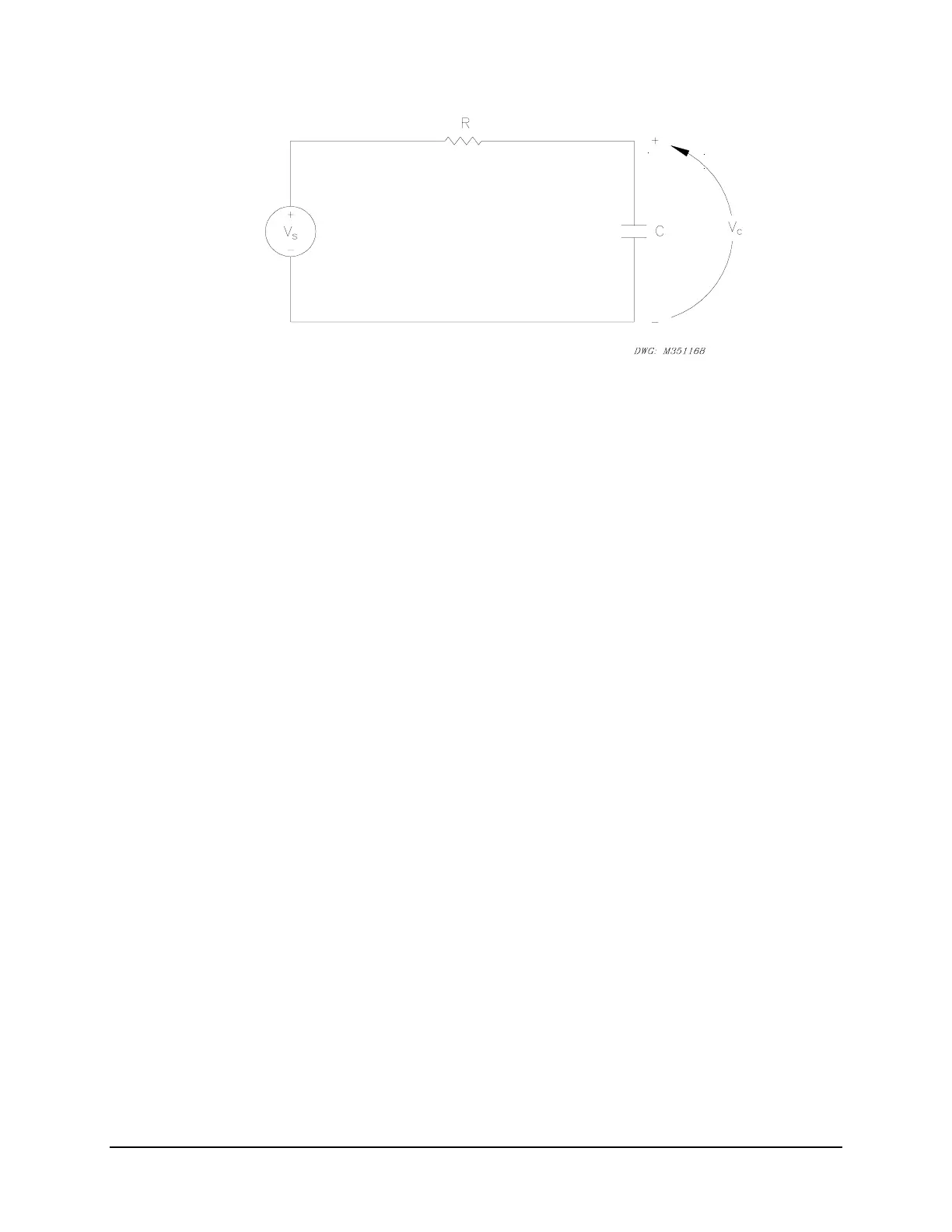
Figure SECTION 8: .10: Voltage V
S
Applied to Series RC Circuit
In the analogy:
Voltage V
S
in Figure SECTION 8: .10 corresponds to the step current input in
Figure SECTION 8: .9 (top).
Voltage V
C
across the capacitor in Figure SECTION 8: .10 corresponds to the response
of the thermal demand meter in
Figure SECTION 8: .9 (middle).
If voltage V
S
in Figure SECTION 8: .10 has been at zero (V
S
= 0.0 per unit) for some time,
voltage V
C
across the capacitor in Figure SECTION 8: .10 is also at zero (V
C
= 0.0 per unit). If
voltage V
S
is suddenly stepped up to some constant value (V
S
= 1.0 per unit), voltage V
C
across
the capacitor starts to rise toward the 1.0 per unit value. This voltage rise across the capacitor is
analogous to the response of the thermal demand meter in
Figure SECTION 8: .9 (middle) to the
step current input (top).
In general, since voltage V
C
across the capacitor in Figure SECTION 8: .10 cannot change
instantaneously, the thermal demand meter response is not immediate either for the increasing or
decreasing applied instantaneous current. The thermal demand meter response time is based on
the demand meter time constant setting DMTC (see
Table SECTION 8: .5). Note in
Figure SECTION 8: .9, the thermal demand meter response (middle) is at 90% (0.9 per unit) of
full applied value (1.0 per unit) after a time period equal to setting DMTC = 15 minutes,
referenced to when the step current input is first applied.
The SEL-351P updates thermal demand values approximately every 2 seconds. The factory
default Access Level 2 Demand Meter Time Constant setting is DMTC = 5 minutes.
Rolling Demand Meter Response (EDEM = ROL)
The response of the rolling demand meter in
Figure SECTION 8: .9 (bottom) to the step current
input (top) is calculated with a sliding time-window arithmetic average calculation. The width of
the sliding time-window is equal to the demand meter time constant setting DMTC (see
Table
SECTION 8: .5). Note in
Figure SECTION 8: .9, the rolling demand meter response (bottom)
is at 100% (1.0 per unit) of full applied value (1.0 per unit) after a time period equal to setting
DMTC = 15 minutes, referenced to when the step current input is first applied.



 To Next Page