Page 105
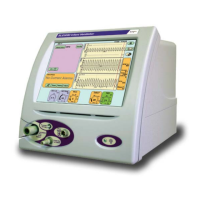
18.1.0.10 When looking at the parameter
settings, what do I record?
The setting in the upper right hand corner of the
parameter window is what has been set. The
numbers with in the eyebrow are the measured
values. This is what is actually happening, and
therefore, this is what is recorded. They are not
always exactly the same value as the value
depends on the resistance or compliance of the
lungs, condition of the patient circuit etc.
18.1.0.11 Where do I set the Trigger Sensitivity?
When a flow sensor is being used pressing the “Set
Trigger” button in the mode panel will activate the
breath detection threshold along the middle of the
flow waveform window. This threshold is preset at
0.6 l/min. On first entering a mode the “Set Trigger”
button will flash.
This setting will not be achievable for a VLBW
infant, and therefore needs adjusting. The most
sensitive setting is 0.2 l/min. However at this level,
there may be some auto triggering. Settings of 0.4
or 0.6 l/min appear preferable.
When not using a flow sensor. A bar appears below
the waveform display window. To increase the
trigger sensitivity, press on the bar and the up and
down arrows will appear. Use the arrows to
increase, or decrease the sensitivity along the bar.
18.2 Mode Related Questions
18.2.0.1 What is meant by Targeted Tidal
Volume?
The user selects the appropriate volume. This
volume is then achieved, limited, and maintained by
pressure. Changes in resistance and compliance
are automatically accommodated.
18.2.0.2 What is the meaning of Compliance
and Resistance?
Compliance is defined as the relationship between a
change in volume and a change in pressure. In the
early stages of the disease a lung is often referred
to as non compliant. In other words there is little or
no elasticity making the opening up of the alveoli
difficult.
Resistance is the relationship of pressure to flow i.e.
the resistance offered by the airway to the flow. If
the resistance is high, it means that the lungs are
stiff and therefore requiring higher pressures to
ventilate effectively.
Normal Resistance and Compliance values in term
newborn infants
18.2.0.3 How do I minimise the Apnoea alarm in
CPAP?
The trigger sensitivity needs to be appropriately
set.It is advisable to remove the flow sensor. Set the
“Cycle Fail” alarm at or just above the selected
CPAP level. Set the low pressure alarm below the
CPAP level.
Pulmonary
compliance
2 - 2.5ml/cmH
2
O/kg
Chest wall
compliance
> 4ml/cmH
2
O
Pulmonary
resistance
20 - 40 cmH
2
O/L/sec
Resistive
work
20 - 30 gm/cm/kg
Newborn RDS Newborn BPD
Pulmonary
compliance
<0.6ml/cmH
2
O/kg <1.0ml/cmH
2
O/kg
Chest wall
compliance
---- ----
Pulmonary
Resistance
>40cmH
2
O/L/sec
>150cmH2O/L/sec
Resistive
work
30 - 40gm-cm/kg 40gm-cm/kg


 To Next Page