Page 176
31.1.18 Pressure Change Alarm
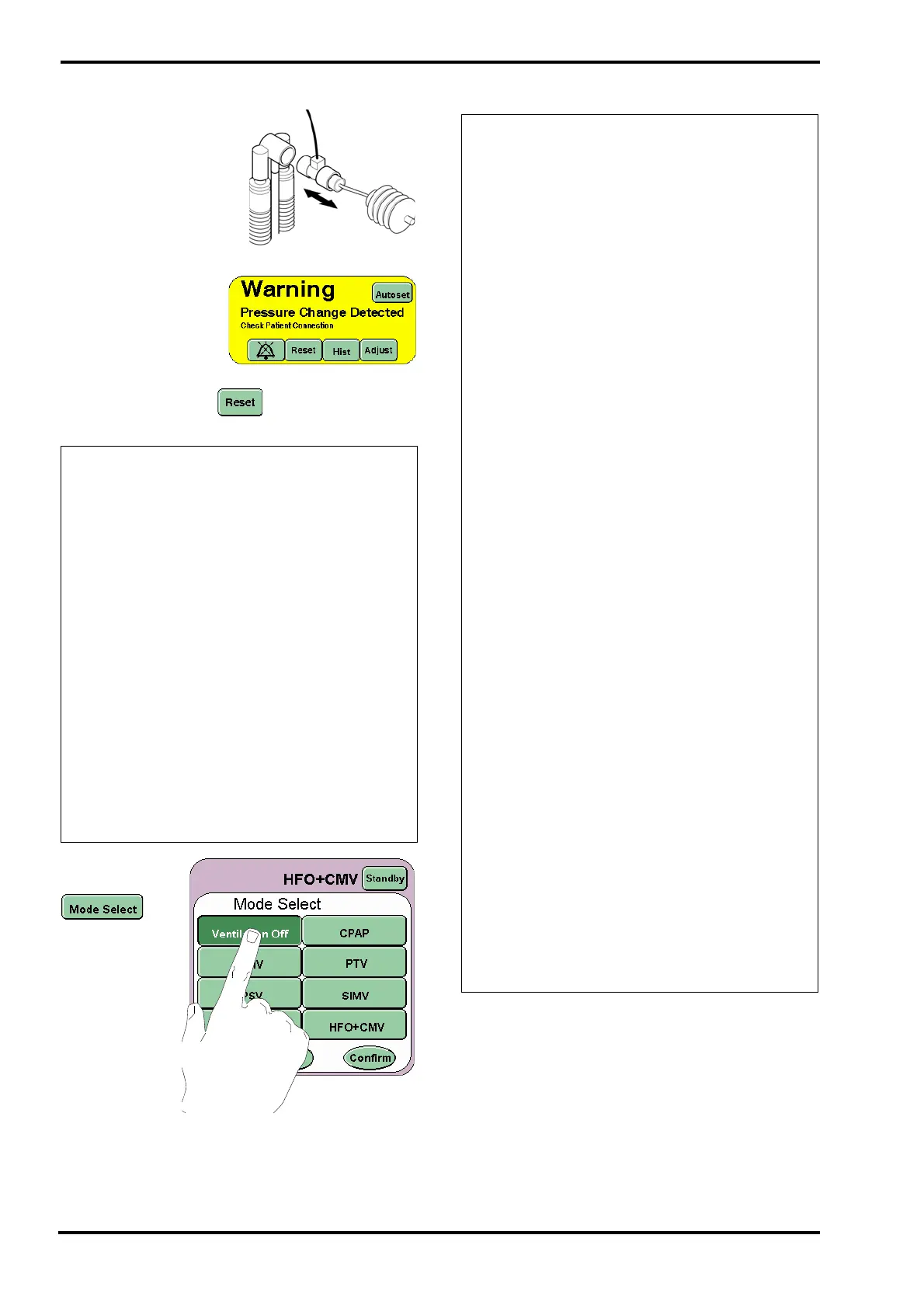
Step 61. Disconnect the
flow sensor and test lung
from the ET manifold for a
maximum of 3 seconds
then reconnect.
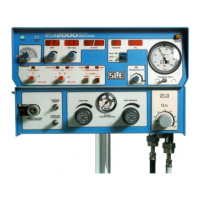
Verify that:
The visual and audible
“Pressure Change
Detected” alarm is
triggered.
Press the reset button to clear the alarm
panel of the alarm notification.
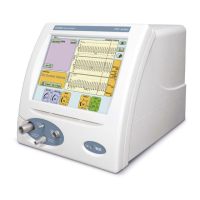
Step 62. Press
the Mode Select
button and
select
Ventilation Off
from the Mode
Select panel.
Press the
confirm button
to enter the
Ventilation Off
mode.
Step 63. Functional testing is complete.
Action: If the alarm is not triggered under
alarm conditions, perform the following
actions in the order suggested below. After
each action, retest the ventilator. If the
ventilator successfully passes all these tests
after performing one of these actions go to
Step 62.
• Replace the flow sensor cable.
• Repeat calibration process with both ends
of flow sensor occluded.
• Check patient circuit is set up correctly as
shown in Section 12: Ventilator Set-up. Pay
close attention to proximal airway, fresh
gas connection and the expiratory limb.
• Replace the flow sensor.
If the fault continues after checking all the
possible causes, remove the ventilator from
service and contact an SLE approved
engineer
Action: If the ventilator fails these tests for
any of the following reasons
• Manual breath is not delivered/Test lung
fails to inflate
• Apnoea condition not detected
• Apnoea condition not cancelled
• Trigger not detected
• “Continuing Positive Pressure” alarm
not triggered
• Waveform parameters do not match the
set parameters
• “High Pressure” alarm not activated
under high pressure condition
• Peep not maintained during high alarm
condition
• Fresh gas flow not switching off
• Ventilator not oscillating in inspiratory
or expiratory phase
• Waveform not present in relevant
window
• I:E ratio displaying incorrect value for
setting
• HFO activity selection not functioning
Perform the following actions in the order
suggested below. After each action, retest the
ventilator. If the ventilator successfully
passes all these tests, after performing one of
these actions, go to Step 62.
• Check patient circuit is set up correctly as
shown in Section 12: Ventilator Set-up. If
you cannot find a fault, replace the
components of the patient circuit and try
again.
• Check the test lung and replace if
necessary.
• Ensure threshold settings are correct.
• Re-calibrate system.
If the fault continues after checking all the
possible causes remove the ventilator from
service and contact an SLE approved
engineer


 To Next Page