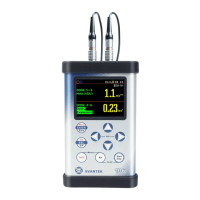
SV 977D User Manual - Appendixes
Note: In the measurement of the signal with the crest factor n > 1.41 the upper linear operating
range for the RMS value is reduced. Its value can be calculated from the equation:
A
n
= A +10 - 20log (n / ) [m], where A is the given range for the sinusoidal signal. E.g. for n = 10
and A = 180 the value of A
10
is equal to = 173 dB.
Frequency range
For the acceleration measurement (+/- 10%) 1 Hz 5 kHz (in the linear measurements
with the HP or HP1 filter)
Note: With the application of another vibration transducer, the frequency range given above for
the HP filter can be different (i.e. wider).
See Chapter C.4 for the Wh and VelMF filters characteristics
Basic error for the acceleration measurement < 0.5 dB
Calibration
Direct by measuring a standard signal generated by an external vibration calibrator.
Indirect by declaring the sensitivity of the transducer (in accordance with the calibration card).
Note: Calibration procedure is given in Chapter 3.3.5 of the Manual.
Accelerometer input
• Connector TNC
• Impedance 40 k / 100 pF (typical)
• Vibration transducers powering IEPE type, 28 V / 1.5 mA current source
Maximum input voltage
SV 977D is the instrument with the II security class according to the international standard IEC 348.
The input voltage should be within the 28 V Peak – Peak
RMS detector (Linear averaging)
• Digital “True RMS“ with Peak detection
• Resolution 0.1 dB
• Range 327.7 dB
• Crest Factor unlimited for signals within 40 kHz band.
Overload detector
The instrument has the built-in overload detectors. Both A/D converter and input amplifier overload conditions
are detected. The overload in the measurement channel (in its analogue part) and the overload of the
analogue / digital converter are both detected. The “overload” indication appears when the input signal
amplitude is 0.5 dB above the declared “Peak measurement range”.


 To Next Page
 Loading...