197
SPECIFICATIONS
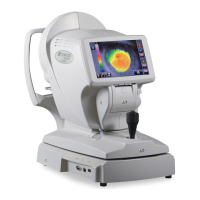
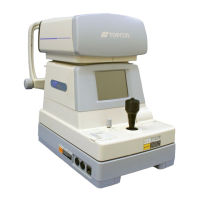
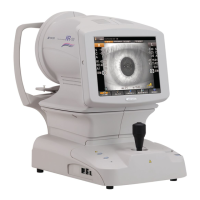
DIMENSIONS AND WEIGHT
Dimensions: 304(W)x521(D)x474-504(H)mm
Weight: 23kg
PURPOSE OF USE
To measure the refractive power of the eye with a function of cornea topography, and to present
the measurement data to the eye care professional.
OPERATIONS AND PRINCIPLE OF OPERATION
To receive light flux from a secondary light source, projected from a light source (point light
source) placed at a position conjugate to the eyeground and formed on the retina, by a CMOS
sensor through a Hartmann board (formed with a two-dimensionally lined small lens array), and
determine the spherical refractive power, cylindrical refractive power, direction of astigmatic axis
and refractive wavefront aberration through computation.
To project a Placido ring to the cornea, receive the reflected image from the cornea surface using
a CCD camera, and determine the curvature radius, corneal refractive power, direction of corneal
astigmatic axis and corneal wavefront aberration through computation, and, to display the distribu
-
tion of curvature radius by mapping.
ELECTRIC RATING
Supply voltage: 100-240VAC, 50-60Hz
Power input: 160VA
LASER ILLUMINATION SYSTEM
Laser output: 1.2mW or less
Laser wavelength: 820nm - 840nm
Laser medium: Super luminescence diode (SLD)
Laser class: 1M
Laser exit: Measuring window
CAUTION
The light emitted from this instrument is potentially hazardous.
The longer the duration of exposure, the greater the risk of
ocular damage. Exposure to light from this instrument when
operated at maximum intensity will exceed the safety guideline
after 120 mins.


 To Next Page