132
GENERAL INFORMATION ON USAGE AND MAINTENANCE
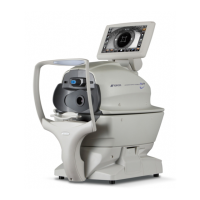
OPERATION PRINCIPLE
Refractometry:
The light source (SLD) for refraction measurement incorporated in the measuring head emits luminous
flux for refraction measurement and project it onto the retina. The camera incorporated in the measur
-
ing head receives the reflected image from the retina. The instrument software installed in the measur
-
ing head performs arithmetic processing of the reflected image and calculates the spherical refractive
power, the astigmatic refractive power and the direction of astigmatic axis necessary for the correction
lens to correct the vision of the subject eye to normal vision.
Keratometry:
The light source (LED) for keratometry illumination incorporated in the measuring head emits light and
project a kerato-ring onto the cornea. The camera incorporated in the measuring head receives the
reflected image from the cornea. The instrument software installed in the measuring head performs
arithmetic processing of the reflected image and calculates the corneal curvature radius. The instru
-
ment software also calculates the corneal refractive power and the direction of corneal principal merid-
ian from the corneal curvature radius.
Tonometry:
The light source (LED) for applanation detection incorporated in the measuring head emits luminous
flux for applanation detection and project it onto the cornea. The measuring nozzle of the intraocular
pressure measuring window blows air onto the cornea. The applanation sensor incorporated in the
measuring head detects that a certain area of the cornea becomes planar by the air. Then, the pressure
sensor incorporated in the measuring head detects the amount of pressure required to flatten the cer
-
tain area of the cornea. The instrument software installed in the measuring head performs arithmetic
processing based on the detected amount of pressure and calculates the intraocular pressure value.
Reference IOP for corneal thickness:
The IOP reference value considering corneal thickness will be displayed by using the following correc-
tion formula* and calculating it in the control section.
Corrected formula ADJ.IOP=MES.IOP-(MES.CCT-A)×B
ADJ.IOP: Corrected IOP
MES.IOP: Intraocular pressure measurement
MES.CCT: Central corneal thickness (CCT) measured
A: Central corneal thickness (CCT) baseline
B: Correction factor
Parameters A and B can be set arbitrarily, but the initial value is
Central corneal thickness (CCT) Baseline A:545 (μm),
Correction factor B:0.050 (mmHg/μm)
It is established.
*The above correction formula has been published in the following literature:
Herndon L, “Rethinking pachymetry and intraocular pressure,”, Rev Ophthalmol, 2002; July; 88-90
Pachymetry:
The light source (LED) for pachymetry measurement incorporated in the measuring head emits slit light
and project it onto the cornea obliquely. The line sensor incorporated in the measuring head receives
the reflected lights from the front and back surfaces of the cornea. The instrument software installed in
the measuring head performs arithmetic processing based on the received lights and calculates the
corneal thickness.
Corneal diameter measurement:
The kerato-ring illumination emitted from the kerato-illumination light source (LED) built into the mea-
surement head is projected into the subject's eye, and the reflected image (anterior image) is received
by the camera built into the measurement head and displayed on the control panel.
After aligning the positioning bar in the anterior images displayed on the control panel, the corneal
diameter is calculated by the software built in the measurement head when a user presses the mea
-
surement button.


 To Next Page