EasyManua.ls Logo

Valleylab CUSA EXcel-8 - A Common Misunderstanding of the Amplitude Setting

Valleylab CUSA EXcel-8
239 pages
Print Icon
To Next Page IconTo Next Page
To Previous Page IconTo Previous Page
Loading...
How
the
TISSUE
Select
Feature
Works
A
Common
Misunderstanding
of
the
Amplitude
Setting
It
has
been
common
practice
to
decrease
the
amplitude
setting
when
encountering
critical
structures.
The
reasoning
behind
this
practice
is
that
the
lower
amplitude
setting
results
in
slower
fragmentation
rate
and
greater
selectivity,
thus
greater
control
to
help
avoid
damage
when
dissecting
near
the
critical
structures.
Look
at
this
reasoning
more
carefully.
True:
Decreasing
the
amplitude
setting
also
decreases
the
fragmentation
rate.
True:
Because
the
fragmentation
rate
is
slower,
the
surgeon
has
a
little
more
time
to
move
the
tip
away
from
a critical
structure
before
damaging
it;
therefore,
the
surgeon
sees
to
have
greater
selectivity
and
control.
False:
The
surgeon
gains
greater
selectivity,
thus
greater
control
and
precision
when
dissecting
near
critical
structures.
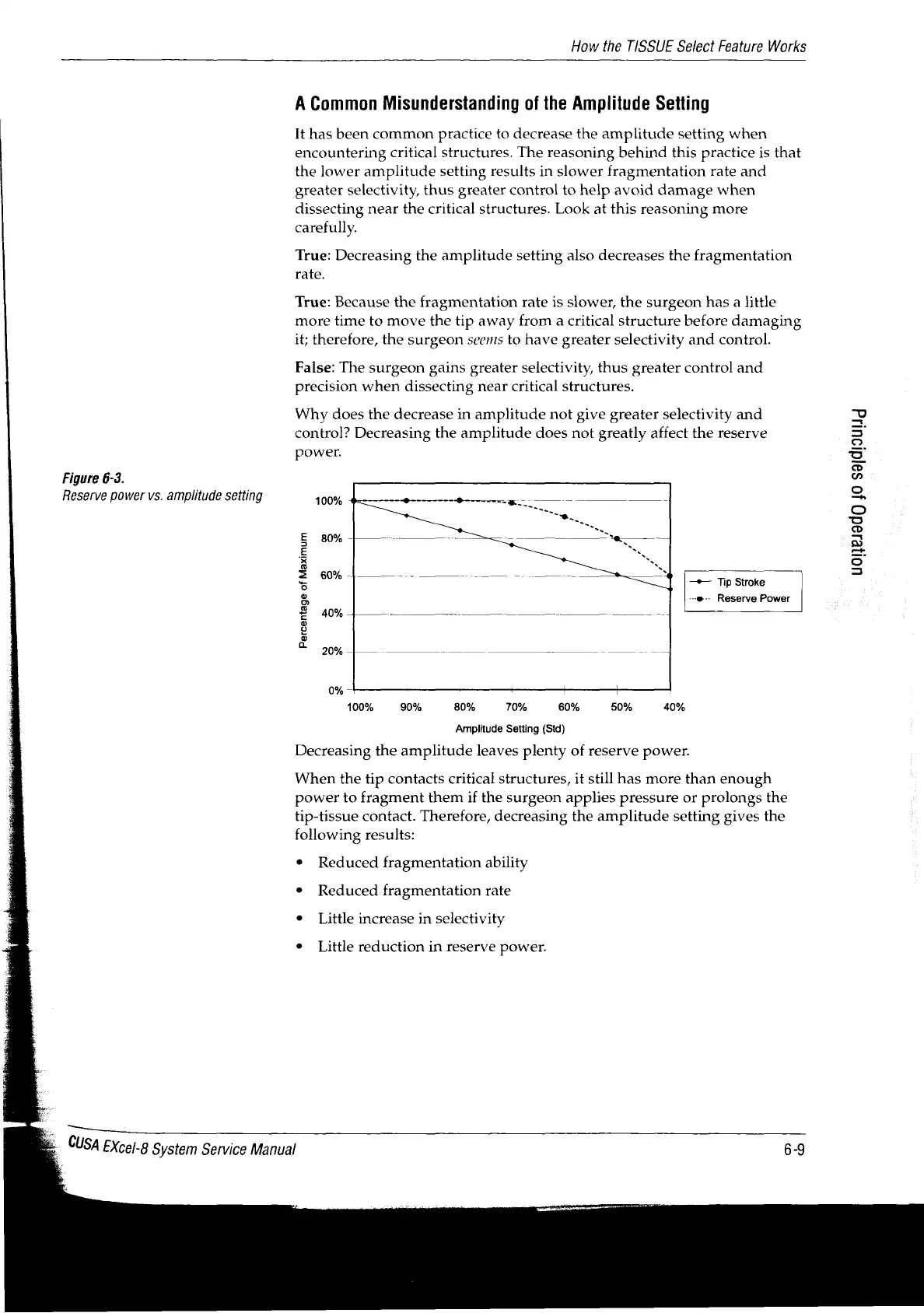
Why
does
the
decrease
in
amplitude
not
give
greater
selectivity
and
p
control?
Decreasing
the
amplitude
does
not
greatly
affect
the
reserve
5
power.
3
|
©
Figure
6-3.
>
Reserve
power
vs.
amplitude
setting
100%
4
e
=
Te
о
τος
τὸ
A
©
E
80%
as
3
E
M
=
5
3
O
M
È
60%
Я
|e
Tip
Stroke
-e-
Reserve
Power
8
40%
-
4
8
È
20%
-
ーー
0%
100%
90% 80%
70%
60%
50%
40%
Amplitude
Setting
(Std)
Decreasing
the
amplitude
leaves
plenty
of
reserve
power.
When
the
tip
contacts
critical
structures,
it
still
has
more
than
enough
power
to
fragment
them
if
the
surgeon
applies
pressure
or
prolongs
the
tip-tissue
contact.
Therefore,
decreasing
the
amplitude
setting
gives
the
following
results:
*
Reduced
fragmentation
ability
e
Reduced
fragmentation
rate
e
Little
increase
in
selectivity
e
Little
reduction
in
reserve
power.
CUSA
EXcel-8
System
Service
Manual
6-9

Table of Contents

Related product manuals