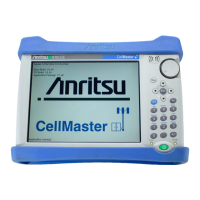
LTE eNodeB Troubleshooting Guide – utilizing Anritsu’s Handheld BTS Master
™
, Cell Master
™
or Spectrum Master
™
with Options 0541, 0542 and 0546
Visit us at www.anritsu.com
Start Here
Use Over-the-Air (OTA) tests to spot-check a
transmitter’s coverage and signal quality. Use
the Direct Connect tests to check transmitter
power and EVM when the OTA test results are
ambiguous.
Troubleshooting Hints
These two tables provide guidance from the first indication of a fault, a poor Key Performance
Indicator (KPI), to the BTS Master, Cell Master or Spectrum Master test, and finally, to the field
replaceable unit.
Key Performance
Indicators vs. Test
Sync
Power
RS
Power
Occupied
BW,
ACLR, &
SEM
EVM
(pk)
EVM
(rms)
Freq
Error
Rx Noise
Floor
OTA EVM
Call/Session Blocking
Power shortage
x x x
Resource Block shortage
x xx xx
UL Interference
x xx
Call/Session Drop
Radio Link Timeout
x x x x x x x
UL Interference
x x
DL Interference
x x x x x x
Test vs. BTS Field
Replaceable Units
Freq Ref
Signal
Generation
MCPA Filters Antenna
Antenna
Down Tilt
Sync Power
x xx x
RS Power
x xx x
Occupied BW
x xx xx
Adjacent Channel Leakage
Ratio (ACLR)
x x xx x
Spectral Emission Mask (SEM)
x x xx x
Error Vector Magnitude Peak
(EVM pk)
x xx
Error Vector Magnitude EVM
(rms)
x x x x
Frequency Error
xx
OTA EVM
x x x x x
x=probable,xx=mostprobable
Locating Over-the-Air Test Spots
To test an eNodeB Over-the-Air (OTA) it is
necessary to find a location with good Sync
Signal (SS) dominance. The SS dominance
measurements are ideal for this task. OTA
testing requires SS dominance readings higher
than 10 dB.
To find a good OTA test site, look for a place
squarely in the sector, a block or two from the
tower, and away from surfaces that may
reflect radio waves. A directional antenna will
help to screen out unwanted signals.
In some urban areas, locating a good OTA site
can be difficult. In these cases, it may be
quicker to connect to the BTS for testing.
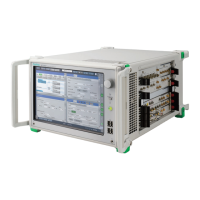
Anritsu BTS Master
™
Direct Connect Transmitter Tests
Transmitter tests can be run while connected
to the:
Output of the eNodeB (Point ”A”).
Test port (Point “B”) which is
essentially the output of the Multi-
Carrier Power Amplifier (MCPA).
Input to the MCPA (Point “C”) if the
signal is accessible
Frequency reference system (Point
“D”) for carrier frequency errors
The goal of these measurements is to increase
data rate and capacity by accurate power
settings, low out-of-channel emissions, and
good signal quality tests. Good signals allow
the cell to generate more revenue and provide
a better return on investment.
The antenna is the last link in the
transmission path. If connected at point “A”, it
is helpful to sweep the antenna(s) at the same
time, to ensure a high quality signal.
Multiple Sector Coverage Checks
Sync Signal Power, Dominance, Cell ID,
and EVM
Sync Signal (S-SS) affects cell size. S-SS is
also used OTA to check coverage. It should be
highest near the tower, declining to a
minimum level at the handoff point. More
information on SS is provided elsewhere in this
guide.
Dominance: The strength of the strongest S-
SS compared to the others.
EVM, RSRP, RSRQ, and SINR all indicate the
quality of the received signal. In this screen,
EVM is measured on the PBCH signal, so as to
not be affected by traffic.
Cell, Group, and Sector ID: Identifies the
source of the OTA signals detected.
Guidelines:
Dominance: Higher than 10 dB for OTA signal
quality testing.
EVM: Established from a known good base
station at a location where the dominance
figure is over 10 dB.
Cell, Group, and Sector ID: Should be set as
defined by engineering.
Consequences:
Poor Dominance: Poor spot to test the BTS
OTA. May be a result of excessive coverage,
which will result in a loss of system capacity
due to excessive co-channel interference.
Poor EVM: Call drops, call blocking, low data
rate, and low capacity.
Wrong Cell, Group or Sector ID: Dropped
handoffs and island sectors.
Common Faults: Antenna down tilt, damaged
antennas, control channel power settings, and
co-channel interference.
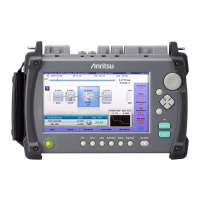
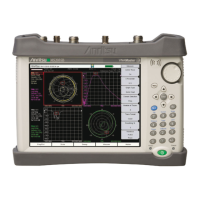
Pass Fail measurements simplify OTA and Direct
Connect Transmitter Test with user specified Limit sets





 To Next Page