346
TRIM AND TILT
ELECTRICAL CIRCUIT TESTS
Trim Gauge Test
STEP 1
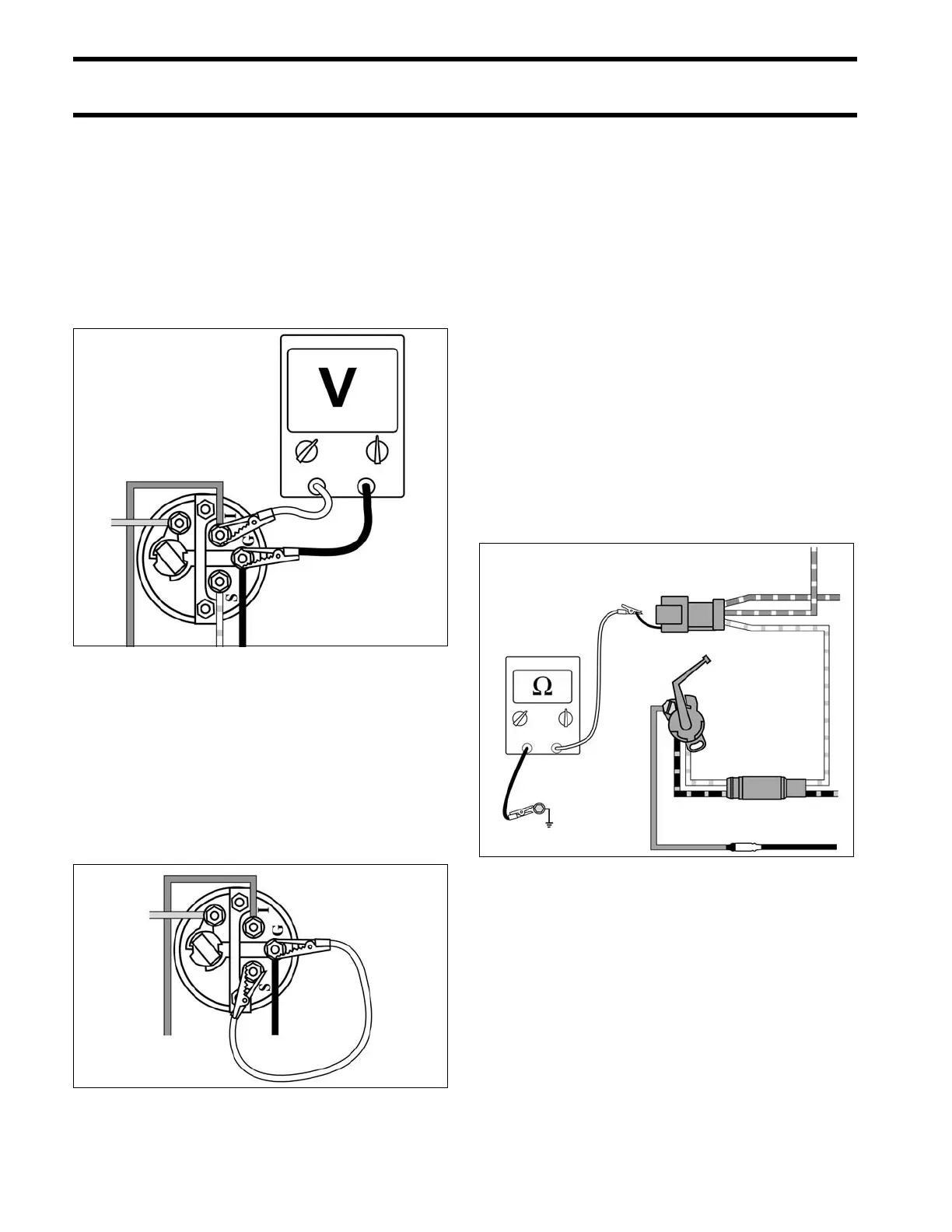
Turn key switch ON. Using a voltmeter , check for
voltage between the trim gauge “I” and “G” termi-
nals.
• If no voltage, check condition of instrument har-
ness, key switch, and engine 10 A fuse.
• If voltage, go to STEP 2.
STEP 2
Remove th e white/t an lead fro m the trim gau ge
“S” terminal. With key switch ON, gau ge shou ld
indicate full-trim DOWN position. Now connect a
jumper wire between terminals “S” and “G.” Gauge
should indicate full-trim UP position.
• If results are different, replace the trim gauge.
• If results agree, refer to Trim Sender Test.
Trim Sender Test
IMPORTANT: To avoid immedia te me ter dam-
age, never apply a multimeter to an electrical cir-
cuit where voltage is present.
Disconnect the 3-pin connector betwee n the
instrument harness and engine trim harness.
Connect an ohmmeter between the white/tan wire,
terminal “C,” of the en gine h arness and a cle an
engine ground.
With the outboard fully DOW N, meter must show
a reading above 80 Ω.
With the outb oard fully UP , meter must show a
reading below 10 Ω.
• If result s agree, refer to Trim Gauge Test on
p. 346.
• If results are different, replace trim sender.
DRC6245
DRC6246A
DRC6247








 To Next Page