Need help?
Do you have a question about the Dranetz hdpq xplorer and is the answer not in the manual?
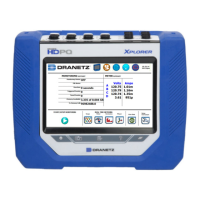
Introduction to the HDPQ Xplorer and its capabilities.
Identification of connectors and controls on the instrument's panels.
Explanation of touchscreen operation, taskbar, and work area.
How to power on, operate, and use the instrument's basic functions.
Instructions for connecting voltage measurement cables.
Instructions for connecting current probes.
Introduction to viewing real-time power quality phenomena.
Displaying parameters using dial-type meters.
Viewing real-time voltage and current waveforms.
Viewing voltage and current harmonics and interharmonics.
Introduction to monitoring setup procedures.
Automated configuration for power quality monitoring.
Step-by-step guided setup for circuit monitoring.
Selecting the appropriate monitoring mode for data capture.
Customizing threshold settings for event triggers.
Completing the monitoring setup process.
Introduction to miscellaneous instrument tasks.
Configuring the instrument's time, date, and time zone.
Configuring Ethernet, WiFi, Bluetooth, VNC, and Modbus connections.
Procedure for updating the instrument's internal program.
Configuring LCD screen settings like backlight and brightness.
Introduction to viewing graphical and information-packed data.
Viewing trend data plots and visualizations.
Viewing and analyzing captured events.
Generating and viewing various types of reports.
Lists available hardware accessories and their part numbers.
Lists available Dranetz software for data analysis.
Provides general specifications such as dimensions and environmental limits.
Details accuracy and range specifications for measured values.
Defines formulas for calculated parameters like power and factor.
Details battery type, capacity, charging, and operation time.
Provides essential safety guidelines for handling batteries.
Step-by-step instructions for replacing the battery pack.
Guidance on verifying connections using phasor diagrams.
Connection diagram and phasor diagrams for single-phase circuits.
Connection diagram and phasor diagrams for 3-phase Wye circuits.
Procedure and safety for connecting potential transformers (PTs).
Procedure and safety for connecting current transformers (CTs).
Defines parameters and formulas used in PQ calculations.
Formula and precision for calculating RMS voltage.
Formula for calculating voltage unbalance based on phase deviation.
Calculation of harmonic voltage distortion normalized to the fundamental.
 General
| Type | Power Quality Analyzer |
|---|---|
| Current Channels | 4 |
| Voltage Range | 1V to 1000V |
| Inrush Current | Yes |
| Power and Energy | Yes |
| Dips and Swells | Yes |
| Voltage Channels | 4 |
| Frequency | 50/60 Hz |
| Transients | Yes |
| Flicker | Yes |
| Communication Interfaces | USB, Ethernet, Wi-Fi |
| Standards Compliance | IEC 61000-4-30 Class A, EN 50160 |
| Operating Temperature | -10°C to +50°C |

 To Next Page