Resolution: Entry for the number of pulses/revolution (for a rotary sensor) or μm/pulse (for a
linear sensor) in relation to the 1st measuring device.
Verification: Entry for the number of pulses/revolution (for a rotary sensor) or μm/pulse (for a
linear sensor) in relation to the 2nd measuring device.
Gear ratio: This parameter is active if there are two sensors on the selected axis. This parame-
ter enables you to enter the gear ratio between the two sensors. If the two sensors are on the
same moving object, the ratio is 1, otherwise the figure for the ratio must be entered. Example:
There is an Encoder and a proximity switch and the latter is on the moving object that (due to a
gear ratio) moves at twice the speed in relation to the Encoder. The value 2 is therefore entered.
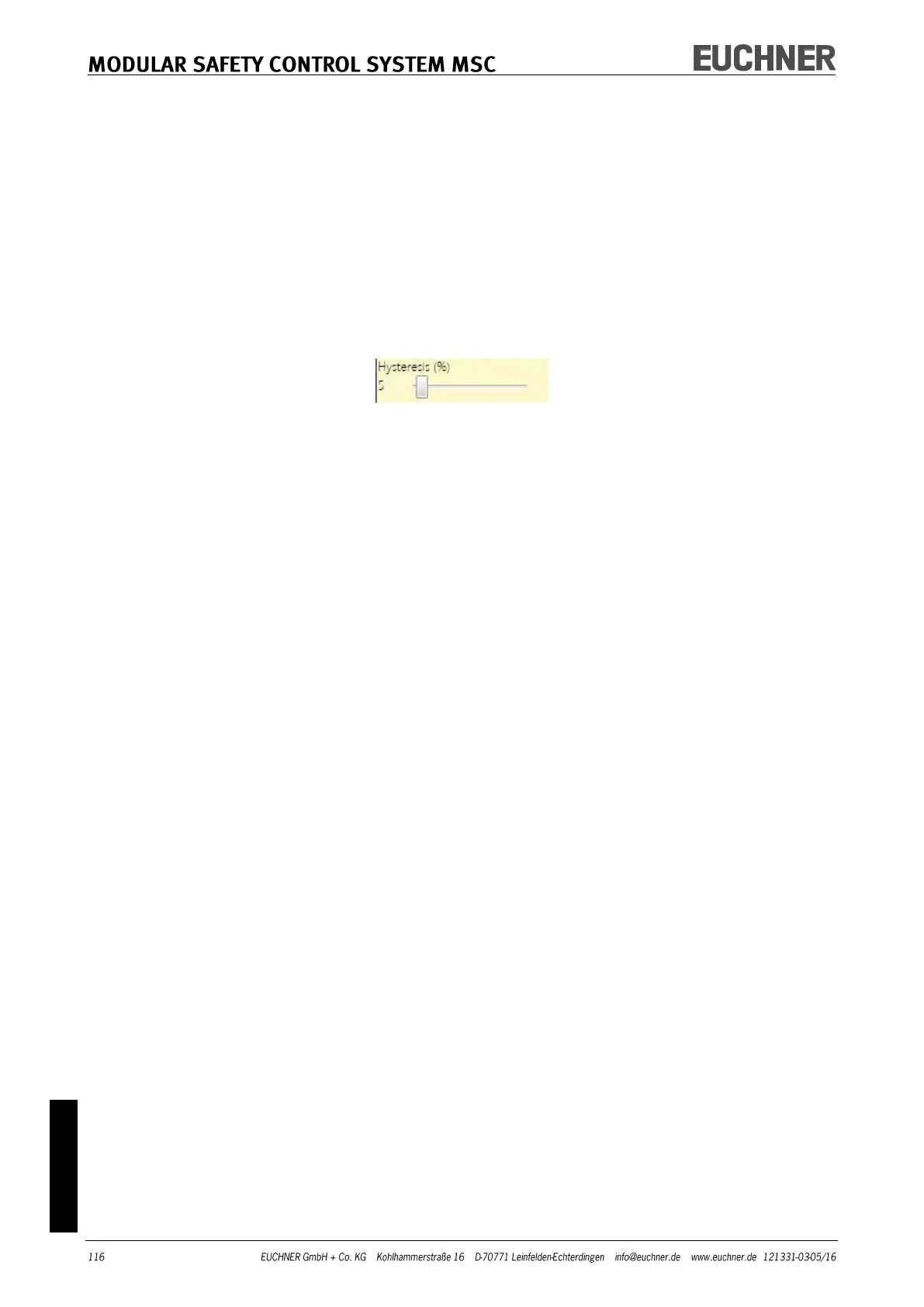
Hysteresis (%): Represents the hysteresis (in percent) below which the speed change is filtered
out. Enter a value other than 1 to prevent continuous switching of the input.
Zero speed limit: Enter in this field the maximum speed that is still corresponds to standstill.
Above this limit the ZERO output on the function block is "0" (FALSE). Conversely, if the speed
measured is below the value entered, the "ZERO" output on the function block is "1" (TRUE).
Speed 1, 2, 3, 4: Enter the highest value for the speed in this field. If the speed is exceeded, the
OVER output on the function block is "0" (FALSE). Conversely, if the speed measured is below the
value entered, the OVER output on the function block is 1 (TRUE).


 To Next Page