Flanger
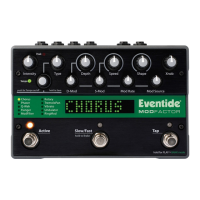
Flanging is similar to Phasing but more intense – deeper, more numerous frequency notches.
Intensity: Effect level.
Type:
Positive: Mixes the feed-forward and feedback signals, non-inverted.
Negative: Mixes the feed-forward and feedback signals, inverted.
Jet: Uses a special arrangement that creates a very extreme effect (like a jet taking off).
Thru-0: Uses two different delay line that flange against each other, so the flange offset goes
through 0.
Depth: Sets the modulation sweep range from narrow to wide.
Speed / Sensitivity: Sets the modulation sweep rate. Speed becomes Sensitivity when Shape is set
to Envelope or ADSR.
Shape: Selects the waveform, or source, of the modulation. The choices are:
Sine
Triangle
Peak
Random
Square
Ramp
SampHold
Envelope: The modulation becomes driven by the amplitude of the audio input.
ADSR: The modulation becomes driven by an ADSR triggered by the amplitude of the audio
input.
Manual: When selected, the Manual Mod parameter will control the modulation.
Delay Offset: Set Delay offset.
Depth Mod: Controls the amount of modulation of the Depth parameter. Analogous to AM
(Amplitude Modulation).
Speed Mod: Controls the amount of modulation of the Speed parameter. Analogous to FM
(Frequency Modulation).
Mod Rate / Mod Sens: Sets the secondary LFO rate – determines how fast the Depth Mod and
Speed Mod “wiggle” their targets. Ranges from 1/8th to 8x the Speed value. Mod Rate becomes
Mod Sens when Mod Source is set to Envelope or ADSR.
Mod Source: Selects the secondary LFO waveform, or source. The choices are:
Sine
Triangle
Peak
•
•
•
•
•
•
•
•
•
•
•
•
•
•
•
•
•
•
•
•
•
•
•
•
•
•
•
11. ALGORITHM GUIDE



 To Next Page