Reverse
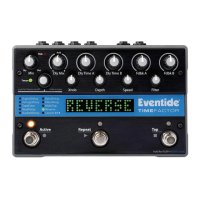
Reverse audio effects. Audio is broken into segments, are played backwards and spliced. Crossfading at
the splice points prevents nasties. X-Fade controls the length of the crossfade. Small values result in fast
crossfades adding an audible rhythm to the effect. Larger values result in long crossfades and a smoother
reverse sound.
Mix: wet/dry mixer, 100% is all wet signal.
Delay Mix: Controls the relative level of Delay A and Delay B. Delay Mix’s mixing behavior depends
on whether you’re using mono or stereo outputs.
For mono output:
Delay Mix = 0%, output 1 will have only delay A’s contribution.
Delay Mix = 50%, output 1 has an equal amount of delay A and delay B.
Delay Mix = 100%, output 1 will have only delay B’s contribution.
For stereo output:
Delay Mix = 0%, both outputs will have only delay A’s contribution.
Delay Mix = 50%, delay A goes to output 1 only and delay B goes to output 2 only.
Delay Mix = 100%, both outputs will have only Delay B’s contribution.
Delay A: Sets delay time for Delay A output. With Tempo Sync OFF, delay is displayed in ms. With
Tempo Sync ON, delay can be sync’d to the tempo and is displayed as a rhythmic sub-division of the
tempo beat value - changing this from 0 to a whole note in common note increments.
Delay B: Same as Delay A
Feedback A: Controls level of Feedback A, the number of repeats.
Feedback B: Same as Feedback A.
X-Fade: In Reverse, the audio segments are read backwards and must be spliced. Crossfades occur
at the splice point to prevent abrupt changes that could result in glitching or clicking. X-Fade sets
the rate of the crossfade. Small values result in fast crossfades and a more audible rhythm for the
reverse effect, larger values more gradual crossfades and a smoother reverse sound. Crossfade rate
is variable from 2 ms to 200 ms.
Modulation Depth: Selects the amount of modulation (0 = Off, 10 = Max).
•
•
•
•
•
•
•
•
•
•
•
•
•
•
11. ALGORITHM GUIDE



 To Next Page