Ramp
SampHold
Envelope: Mod Rate becomes Mod Sens and is driven by the amplitude of the audio input.
ADSR: Mod Rate becomes Mod Sens driven by an ADSR triggered by the amplitude of the audio
input.
Manual: When selected, the Manual Mod parameter will control the modulation.
Performance Parameters
Retrigger: Retriggers the primary and secondary modulation LFOs to the beginning of their cycles. Useful
for re-syncing during playback, or creative effects.
Speed / Brake: The Brake engages while this switch is pressed. Short-press to toggle between Fast and
Slow. Long-press to engage Brake.
Fast / Slow: Press to toggle between Fast and Slow, which slows the primary and secondary LFOs by a
predetermined factor. The Brake does not engage while this switch is pressed.
Brake (M): Slows the LFOs at a constant rate and pauses the LFOs until the switch is released.
Factory Presets
Chopper Trem
Flutter Trem
HyperChopTrem
I Walk Alone
Modacity
Panning Tremo
Pulsing Trem
RampChopper
Special Agent Factor
Square Chopper
Tumbleweed Trem
Tricerachorus
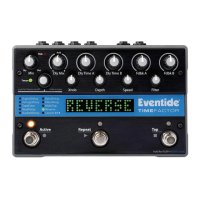
TriceraChorus is inspired by the classic tri-choruses and stompbox choruses of the 1970s and early
1980s. These units used bucket brigade delay (BBD) chips to create chorusing. TriceraChorus pairs rich
BBD-style trichorusing with another classic effect of the 1980s: Eventide MicroPitch detuning. This
effect can be used to thicken the sound, to add static chorusing, and to spread the stereo field by detuning
the left and right signals in opposite directions.
TriceraChorus has three chorus voices: Left(L), Center(C), and Right(R). Each voice uses a dedicated LFO
to modulate a delay at the frequency set by the Rate knob. The modulated signals for the Left and Right
voices are -120 and 120degrees out of phase relative to the Center modulation signal. The combination
of the three modulated delays creates lush chorus sounds.
•
•
•
•
•
•
•
•
•
•
•
•
•
•
•
•
•
•
•
•
11. ALGORITHM GUIDE



 To Next Page