creates dynamic effects that react with more or less intensity based on the harmonic content of the input
audio.
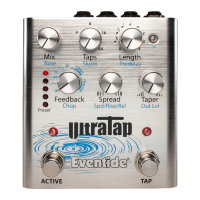
Mix: Wet/dry mixer, 100% is all wet signal.
Length: Total length of the delay line. This length is split into 8 subdivisions on which the comb
filters can be staggered.
Rhythm: Represents the rhythm pattern of the comb filters. Each digit indicates the subdivision on
which a comb filter is positioned. “1.3.5.7” will sound like even quarter notes since the four comb
filters are evenly spaced on the 1st, 3rd, 5th, and 7th subdivisions.
Feedback: The feedback level of each of the comb filters. Feedback type 1 [FB1] maintains the
pattern set by the rhythm knob, whereas feedback type 2 [FB2] degrades the pattern as it repeats.
Resonance: Affects how intensely the comb filters resonate. The comb filters will ring out more
intensely as the resonance increases in either the positive or negative direction. Resonance set to 0
will acts as multi-tap delay without any additional resonant tones.
Reverb: Controls the amount of reverb in the comb filter path.
Note 1: Tunes the note values that trigger each respective comb filter. When resonance is positive,
all integer multiples of this frequency will resonate. When the resonance is negative, only odd
multiples of this frequency will resonate. These note values also affect the high and low pass filters
surrounding each comb filter. When resonance is set to 0, these knobs can still be used to filter the
delays.
Note 2: Same as Note 1.
Note 3: Same as Note 1.
Note 4: Same as Note 1.
Factory Presets
Andy Warhol On The Run
Beecuz
Cascade
Cavern
Clean Delay
Dissonant Repeater
Electrons
Filtered Multitap
Gumdrop
Raag Malhar
Reno
ResoVerb
Saverence
Scary Chord
Spelunking
Submerged
The Beautiful
Thor’s Bells
Tick Tock
Transcendental Dolphin
•
•
•
•
•
•
•
•
•
•
•
•
•
•
•
•
•
•
•
•
•
•
•
•
•
•
•
•
•
•
11. ALGORITHM GUIDE



 To Next Page