FT-111, User Manual Rev. 2.0.0, June 2022 Page 21 of 137
Step 5: RS 232C Serial Ports
FT-111 weighing terminal has 2 x RS232C serial ports on the main board which are galvanically isolated from
other circuitry to increase the EMC immunity. RS232C serial ports are named as RS232C-1 and RS232C-2 in
set up menu and as Int 1 and Int 2 on the electronic board. The use of these serial ports and specifications are
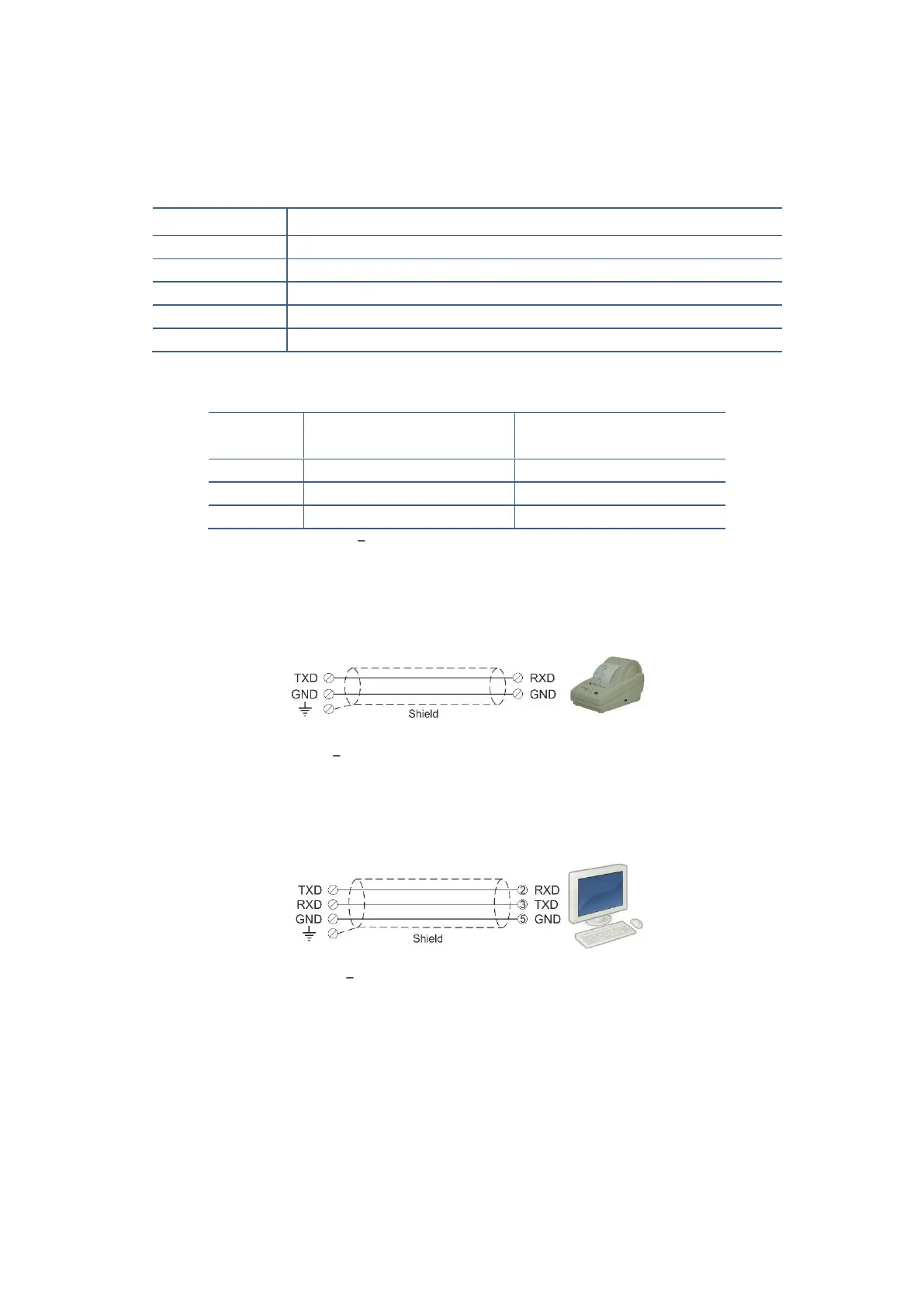
described in the Table 4-2 and their pin configuration is shown in Table 4-3
Interfacing with printer, PC, PLC, remote display etc.
Continuous, Fast Continuous, Printer, BSI Protocol, or Modbus RTU
1200 / 2400 / 4800 / 9600 (Default) / 19200 / 38400 / 57600 bps
Even, Odd or No (default)
1 start bit and 1 stop bit
Table 4-2 - RS 232C Serial Interface Specifications
Table 4-3 Pin configuration of RS 232C terminals
2 wire connection to peripherals: RS 232C serial connection is done with two wires as indicated below in
Figure 4.9. if there is no data entry to the weighing terminal. Typical applications are printer and remote
display connections.
Figure 4.9 2 wire RS 232C connection with a printer or PC
3 wire connection to the peripherals: RS 232C serial connection is done with three wires as indicated below
in Figure 4.10 for bidirectional interfacing. Typical application is bidirectional BSI format interfacing with PC
or PLC.
Figure 4.10 3 wire RS 232C connection with a PC or PLC


 To Next Page