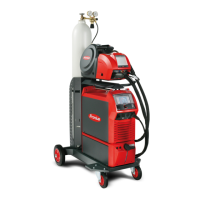
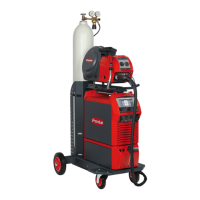
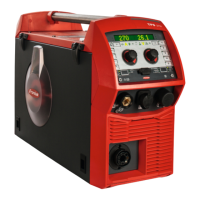
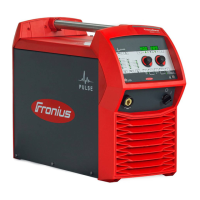
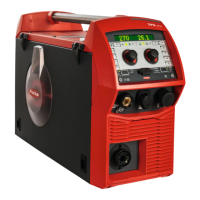
The Fronius TPS 270i C is a fully digitized, microprocessor-controlled inverter power source with an integrated 4-roller wire drive, designed for MIG/MAG welding, TIG welding, and MMA welding. Its modular design and potential for system add-ons ensure high flexibility, while its compact size makes it ideal for mobile applications in construction sites or repair workshops. The power source can be adapted to various specific situations.
Function Description
The device's central control and regulation unit, coupled with a digital signal processor, manages the entire welding process. Continuous measurement of actual data during welding allows the device to respond immediately to changes, with control algorithms ensuring the desired target state is maintained. This results in a precise welding process, exact reproducibility of all results, and excellent weld properties.
The TPS 270i C supports a variety of welding packages, characteristics, and processes:
- Standard Welding Package (4,066,012): Enables MIG/MAG standard synergic welding.
- Pulse Welding Package (4,066,013): Enables MIG/MAG pulse synergic welding.
- LSC Welding Package (4,066,014): Enables the LSC (Low Spatter Control) process (requires Standard Welding Package).
- PMC Welding Package (4,066,015): Enables the PMC (Pulse Multi Control) process (requires Pulse Welding Package).
- CMT Welding Package (4,066,016): Enables the CMT (Cold Metal Transfer) process (requires Standard and Pulse Welding Packages).
- ConstantWire Welding Package (4,066,019): Enables constant current or constant voltage operation during brazing.
Without any welding packages, the device offers MIG/MAG standard manual welding, TIG welding, and MMA welding.
Welding Methods and Processes:
- MIG/MAG Pulse Synergic Welding: A pulsed-arc process with controlled material transfer, ensuring low-spatter welding and precise work across the entire power range.
- MIG/MAG Standard Synergic Welding: Covers dip transfer arc, intermediate arc, and spray arc, providing material transfer across the full power range.
- PMC Process (Pulse Multi Control): A pulsed arc welding process with high-speed data processing, precise recording of process status, and improved droplet detachment, allowing faster welding with a stable arc and even penetration.
- LSC Process (Low Spatter Control): A low-spatter dip transfer arc process that lowers current before the short circuit bridge is broken, with re-ignition at significantly lower welding current values.
- SynchroPulse Welding: Available for all processes, it cyclically changes welding power between two operating points, achieving a flaking seam appearance and non-continuous heat input.
- CMT Process (Cold Metal Transfer): Requires a special CMT drive unit. Its reversing wire movement improves droplet detachment and dip transfer arc properties, offering low heat input, less spattering, reduced emissions, and high process stability. It is suitable for joint welding, cladding, brazing, and light-gauge sheet welding with minimal distortion.
- CMT Cycle Step Welding Process: A further development of CMT, offering the lowest heat input by cyclically switching between CMT welding and adjustable pauses, maintaining weld seam continuity.
- SlagHammer Function: Implemented in all steel characteristics, it knocks off slag from the weld seam and wire electrode end via a reversing wire movement without an arc before welding, ensuring reliable and precise arc ignition.
- Stitch Welding: Allows cyclical interruption of all welding processes for targeted heat input control, useful for rippled weld seams, tacking light-gauge sheets, or automatic spot welding.
Important Technical Specifications
The TPS 270i C is available in several voltage configurations:
- TPS 270i C: Mains voltage (U1) 3 x 400 V. Max. effective primary current (I1eff) 9.7 A, Max. primary current (I1max) 15.3 A. Mains fuse 16 A slow-blow.
- TPS 270i C /nc: Mains voltage (U1) 3 x 380 / 400 / 460 V. Max. effective primary current (I1eff) 9.5 A (3x380V), 9.7 A (3x400V), 8.5 A (3x460V). Max. primary current (I1max) 16.0 A (3x380V), 15.3 A (3x400V), 13.4 A (3x460V). Mains fuse 16 A slow-blow.
- TPS 270i C /MV/nc: Mains voltage (U1) 3 x 200 / 230 / 380 / 400 / 460 V. Max. effective primary current (I1eff) 16.9 A (3x200V), 15.1 A (3x230V), 9.5 A (3x380V), 9.7 A (3x400V), 8.5 A (3x460V). Max. primary current (I1max) 26.5 A (3x200V), 23.7 A (3x230V), 16.0 A (3x380V), 15.3 A (3x400V), 13.4 A (3x460V). Mains fuse protection 35 A slow-blow (3x200/230V), 16 A slow-blow (3x380/400/460V).
- TPS 270i C /S/nc: Mains voltage (U1) 3 x 460 / 575 V. Max. effective primary current (I1eff) 9.1 A (3x460V), 7.2 A (3x575V). Max. primary current (I1max) 14.3 A (3x460V), 11.4 A (3x575V). Mains fuse 20 A slow-blow.
Common specifications across models:
- Mains voltage tolerance: -15 / +15%.
- Grid frequency: 50/60 Hz.
- Cos phi (1): 0.99.
- Max. permitted mains impedance Zmax at PCC: 117 mOhm.
- Recommended residual current circuit breaker: Type B.
- Welding current range (I2): MIG/MAG 3 - 270 A, TIG 3 - 270 A, Rod electrode 10 - 270 A.
- Welding current at 10 min/40 °C (104 °F): 40% / 270 A, 60% / 220 A, 100% / 190 A.
- Output voltage range (U2): MIG/MAG 14.2 - 27.5 V, TIG 14.1 - 20.8 V, Rod electrode 20.4 - 30.8 V.
- Open circuit voltage (U0 peak/U0 r.m.s): 57 V (for 3x400V), 66 V (for 3x380/400/460V and 3x200/230/380/400/460V), 68 V (for 3x460/575V).
- Protection class: IP 23.
- EMC emission class: A.
- Dimensions L x W x H: 687 x 276 x 445 mm (27.0 x 10.9 x 17.5 in.).
- Weight: 33.1 kg (73.0 lb) for 3x400V, 32.5 kg (71.7 lb) for 3x380/400/460V, 33.2 kg (73.1 lb) for 3x200/230/380/400/460V, 30.4 kg (67.0 lb) for 3x460/575V.
- Max. noise emission (LWA): 69 dB (A).
- Max. shielding gas pressure: 7 bar (101.5 psi).
- Wire speed: 1 - 25 m/min (40 - 980 ipm).
- Wire drive: 4-roller drive.
- Wire diameter: 0.8 - 1.6 mm (0.03 - 0.06 in.).
- Wirespool diameter: max. 300 mm (max. 11.8 in.).
- Wirespool weight: max. 19.0 kg (max. 41.9 lb).
- Idle state power consumption at 400 V: 31 W (for 3x400V and 3x380/400/460V), 35.9 W (for 3x200/230/380/400/460V).
- Power source efficiency at 270 A / 30.8 V: 90%.
Usage Features
The control panel allows easy adjustment of welding parameters, which are displayed during welding. The synergic function automatically adjusts other welding parameters when an individual parameter is changed.
- Parameter Selection: Left and right adjusting dials allow selection of parameters like material thickness, welding current, wire speed, arc length correction, welding voltage, and pulse/dynamic correction. Special functions (F1/F2) can be assigned to frequently used parameters.
- EasyJob Mode: Five EasyJob buttons enable quick saving and retrieval of up to five operating points.
- Welding Process Selection: Buttons for PULS SYNERGIC, SYNERGIC, MANUAL, LSC/PMC, STICK/TIG, and CMT/SP modes.
- Mode Selection: Buttons for 2-step, 4-step, Special 4-step, Special 2-step, and other special modes depending on function packages.
- Gas-test Button: For setting the shielding gas flow rate.
- Wire Threading Button: For threading the wire electrode without gas or current.
- Filler Metal Selection: Allows selection of filler metal, wire diameter, shielding gas, and characteristic.
- Setup Menu: Provides access to detailed settings for process parameters (start/end of welding, gas setup, process control, spot welding, stitch welding, component monitoring, electrode setup, TIG setup, process mix, R/L alignment), and general settings (units, standards, hold mode, display brightness, F1/F2 parameters, Favourites button, system data, interior lighting, factory reset, web password reset, JobMaster display, spot welding mode).
- SmartManager (Power Source Website): Offers remote access to system data, documentation, job data, settings, backup & restore, user management, signal visualization, updates, function packages, characteristics overview, and screenshots.
Maintenance Features
The device requires minimal care and maintenance under normal operating conditions.
- Regular Checks:
- Every start-up: Check mains plug, mains cable, welding torch, interconnecting hosepack, and grounding connection for damage. Ensure 0.5 m clearance around the device for cooling air.
- If necessary: Remove fin element on the rear of the housing, detach and clean the air filter if dust has accumulated.
- Every 2 months: Clean the air filter (if present).
- Every 6 months: Open the device and blow out the inside with dry, reduced compressed air. Clean cooling air ducts if there is significant dust accumulation. Avoid cleaning electronic components with compressed air from a short distance.
- Safety Inspection: Recommended at least once every 12 months by a qualified electrician, especially after changes, additional parts, conversions, or repairs.
- Calibration: The power source should be calibrated during the same 12-month period as the safety inspection.
- Firmware Updates: Can be performed via the SmartManager website using a USB Ethernet adapter or a PC/laptop connected to the power source via an Ethernet network.
- Coolant Management: Only use manufacturer's original coolant. Do not mix coolants. Dispose of used coolant according to regulations. Check coolant level before welding.
- R/L Alignment: Recommended when starting the device for the first time and after any changes to the welding system components (torch hosepacks, return lead cables, welding power-leads, welding torches, electrode holders, push-pull units) to ensure optimum welding results.
- Troubleshooting: The device is equipped with an intelligent safety system that displays malfunctions, warnings, or status codes as plain text dialogues. The Error menu provides cause and solution descriptions.

 Need help?
 General


 To Next Page