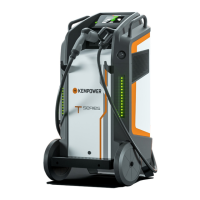
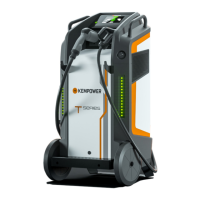
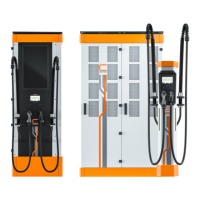
• Kempower Control Unit is a charging point connected to the charging
power unit.
• Kempower AC Satellite is a standalone AC charging point that is not
connected to a charging power unit but directly to the main power
supply.
3.1. Charging power management
The charging power management method of the charging power unit can
be dynamic or static. Dynamic charging power management is one of
the key elements in optimizing the charging of electric vehicles. While it is
possible to later expand the modular configuration, the type of charging
power management cannot be changed from static to dynamic after
installation unless you order a dynamic-ready configuration.
The charging power unit can have 1–12 power modules (1–4 per cabinet)
that each have two independent power channels (2 x 25 kW). The power
distribution module can distribute charging power to 1–8 charging points.
The available charging power depends on the maximum charging power
level that the electric vehicle can accept, the output capacity of the
charging points, and the power capacity of the charging site.
In dynamic charging power management, the power distribution module
routes and re-routes the power channels to the charging points during the
charging session.
With parallel connection (Ds2, Ds4, Ds6, D8) of either C500 or C800 power
modules, up to 8 charging points can deliver charging power in 25 kW steps,
balancing the requirements of the vehicle(s) being charged and the load of
the other charging points. The voltage reference for power calculation when
planning the charging site is 400 V (for C500) and 667 V (for C800).
With series connection (Ds2, Ds4, Ds6) of C500 power modules, the power
distribution module adapts the charger’s voltage to the voltage type of
the vehicle (500 V or 800 V). Up to 6 charging points can deliver charging
power in 50 kW steps, balancing the requirements of the vehicle(s) being
charged and the load of the other charging points. The voltage reference
for power calculation when planning the charging site is 400 V (for 500 V
vehicles) and 800 V (for 800 V vehicles).
In static (S2, S4, S8) charging power management, a fixed amount of
charging power is routed to the charging point(s).
CHARGING EQUIPMENT FOR ELECTRIC VEHICLES INSTALLATION MANUAL
CONFIDENTIAL – CERTIFIED PARTNERS 7 REV 2.40 EN 04-2024


 To Next Page