5. INSTALLING THE CHARGING EQUIPMENT
The recommended maximum distance between the charging power unit
and a connected charging point is approximately 80 m. If longer distances
are necessary, make sure that the requirements are specified in the
electrical design documentation of your site.
5.1. Mechanical installation
DANGER
High-voltage installation. Make sure that the units are correctly isolated and the
lockout-tagout (LOTO) procedure completed when necessary during installation,
service or maintenance work. Know and obey general and local safety regulations
and procedures. Use adequate personal protection equipment (PPE).
5.1.1. Preparing for the installation
CAUTION
High center of gravity. Make sure that the cabinet does not fall over.
NOTICE
One cabinet with four power modules weighs approximately 400 kg. Use appropriate
lifting equipment operated by qualified professionals.
NOTICE
The maximum tilting angle of the charging power unit is 6 degrees. High center of
gravity.
NOTICE
The Liquid Cooled Satellite is shipped in a crate that weighs approximately 150 kg.
Use appropriate lifting equipment operated by qualified professionals.
NOTICE
The electrical installation must be done in dry conditions. If necessary, weatherproof
the installation area before you start the installation.
• Inspect the delivery as soon as possible. Make sure to remove the fixing
brackets. If the equipment is damaged, do not start the installation. For
assistance, contact Kempower Technical Support.
•
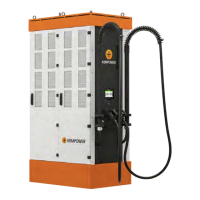
Power Unit is shipped upright on a pallet and wrapped in plastic.
The top of the unit is covered with a plywood board.
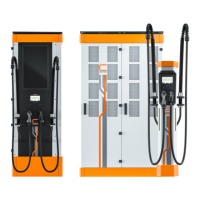
• The charging cables and support springs of the Station Charger
are installed on the unit at the factory. The unit is shipped upright
on a pallet and wrapped in plastic. The top of the unit is covered
with a plywood board.
CHARGING EQUIPMENT FOR ELECTRIC VEHICLES INSTALLATION MANUAL
CONFIDENTIAL – CERTIFIED PARTNERS 42 REV 2.40 EN 04-2024


 To Next Page