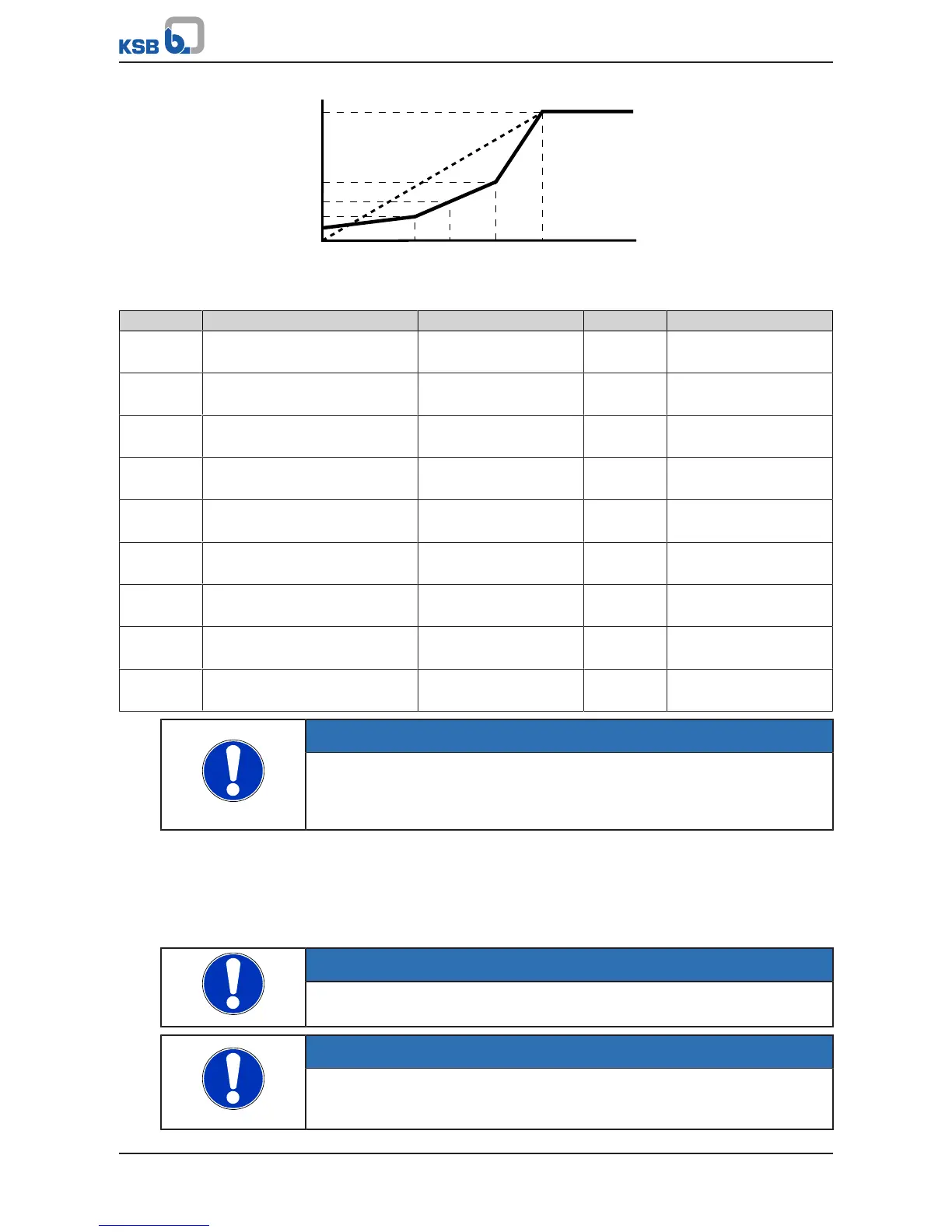
Fig.56: V/f characteristic
Table40: Parameters for changing the V/f characteristic
Parameter Description Possible settings Refers to Factory setting
3-3-2-1 V/f Voltage 0
Data points for the V/f characteristic
0,00...15,00 % 3-2-1-2 2
3-3-2-2 V/f Voltage 1
Data points for the V/f characteristic
0,0...100,00 % 3-2-1-2 20
3-3-2-3 V/f Frequency 1
Data points for the V/f characteristic
0,0...100,00 % 3-2-1-3 20
3-3-2-4 V/f Voltage 2
Data points for the V/f characteristic
0,0...100,00 % 3-2-1-2 40
3-3-2-5 V/f Frequency 2
Data points for the V/f characteristic
0,0...100,00 % 3-2-1-3 40
3-3-2-6 V/f Voltage 3
Data points for the V/f characteristic
0,0...100,00 % 3-2-1-2 80
3-3-2-7 V/f Frequency 3
Data points for the V/f characteristic
0,0...100,00 % 3-2-1-3 80
3-3-2-8 V/f Voltage 4
Data points for the V/f characteristic
0,0...100,00 % 3-2-1-2 100
3-3-2-9 V/f Frequency 4
Data points for the V/f characteristic
0,0...100,00 % 3-2-1-3 100
NOTE
The frequency inverter compensates for motor slip irrespective of the motor control
method. The output frequency displayed (1-2-1-7) therefore corresponds with the
value that is required to actually realise the control variable defined (e.g.
3000rpm).
8.5 Automatic motor adaptation (AMA) of frequency inverter
Automatic motor adaptation (AMA) is a method that calculates or measures the
extended electrical parameters of the motor to ensure optimum motor output and
efficiency. Automatic motor adaptation is used in conjunction with the vector control
methods.
NOTE
Before starting automatic motor adaptation, ensure that the motor name plate
data was parameterised correctly.
NOTE
Automatic motor adaptation can only be started from the Auto Stop state. For this
purpose, the frequency inverter must be in automatic mode and the System Start /
Stop parameter (1-3-1) must be set to Stop.


 To Next Page