1
1-2. Child safety
For safety and security
found in the child restraint system manual.
If your child restraint system is not of the “universal” category (or if you cannot find
information in the table below), please refer to the child restraint system “vehicle
list” for compatibility information or ask the retailer of your child seat.
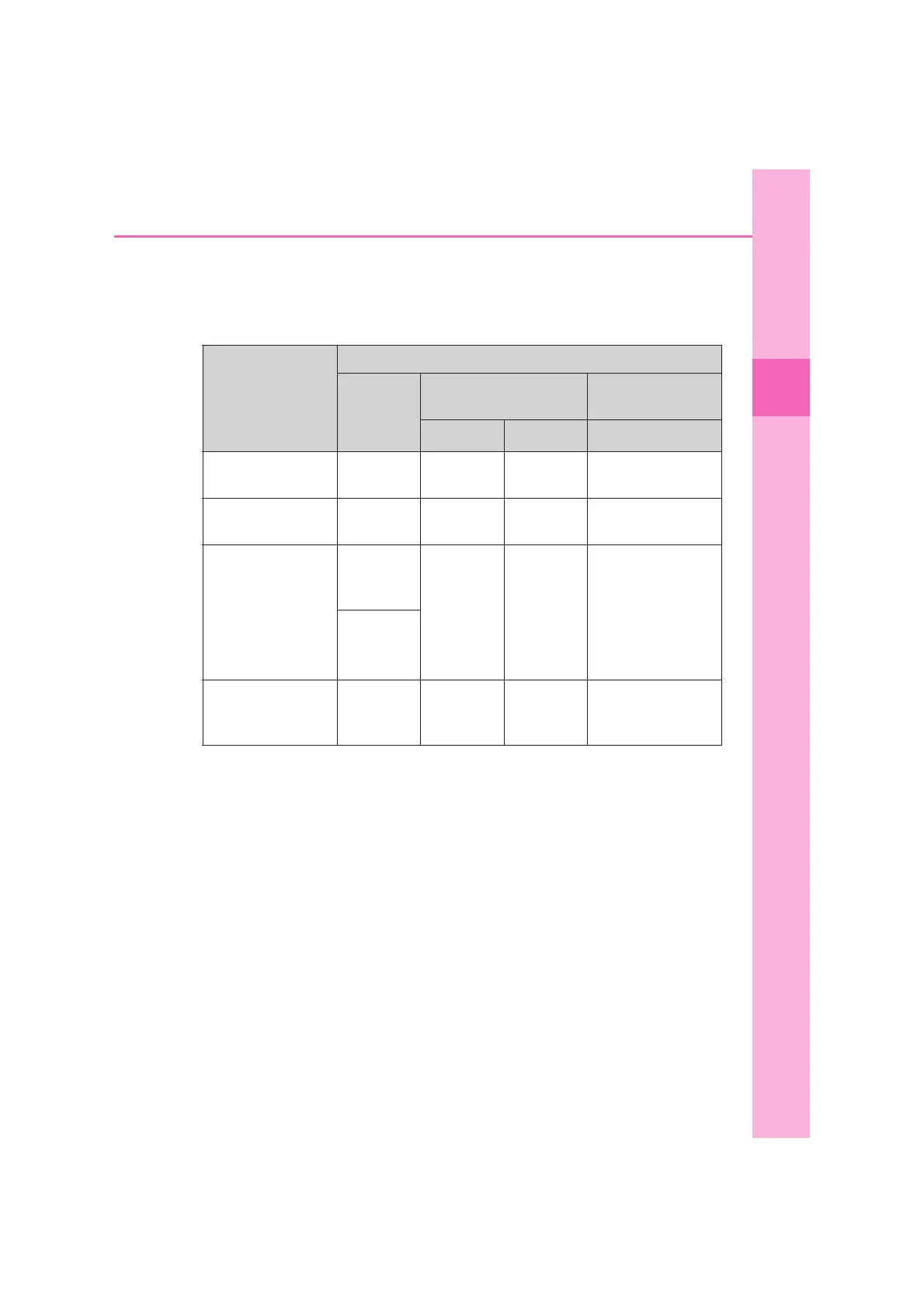
Key of letters inserted in the above table:
X: Not suitable seat position for children in this mass group.
U: Suitable for “universal” category child restraint systems approved for use in this
mass group.
UF: Suitable for forward-facing “universal” category child restraint systems
approved for use in this mass group.
*1
: Adjust the seatback angle to the most
upright position. Move the front seat
fully rearward. If the passenger seat
height can be adjusted, move it to the
upper most position.
*2
: If the head restraint interferes with your
child restraint system, and the head
restraint can be removed, remove the
head restraint. Otherwise, put the head
restraint in the upper most position.
When securing some types of child
restraint systems in rear seat, it may not
be possible to properly use the seat
belts in positions next to the child
restraint without interfering with it or
affecting seat belt effectiveness. Be
Mass groups
Seating position
Front pas-
senger seat
Second seat
Third seat (if
equipped)
Outboard
*2
Center
*2
Outboard
*2
0
Up to 10 kg (22 lb.)
X U U U
0+
Up to 13 kg (28 lb.)
X U U U
I
9 to 18 kg
(20 to 39 lb.)
Rearward-
facing
X
U U U
Forward-fac-
ing
UF
*1, 2
II, III
15 to 36 kg
(34 to 79 lb.)
UF
*1, 2
U U U



 To Next Page