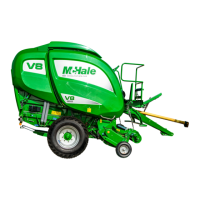
McHale Fusion 2 field operation and adjustments section
9- 1
McHale Fusion 2 round baler wrapper technical service manual
Issue 1: 0208
9. Baler field operation and baler adjustments
9.1 Break in period
McHale recommend a break in period of approximately the first 50 bales or until the
paint within the baler has worn off. Note: It is important to realise that roller and
drive loads increase as the bale size approaches it’s maximum diameter. As such,
frequently making bales greater than the maximum diameter, by pressing and
holding the net button on the control box, is not recommended as this can lead to
premature failure of components. Ensure that all grease points are adequately
greased to prevent rapid wear of components.
9.2 Swath preparation
An optimum baler performance of the McHale
Fusion 2
requires a good swath
preparation in advance. The optimum swath width is 1.40 m.
Note: Swath width is the single most important factor in the preparation for
proper bale formation. A swath narrower or wider than 1.5 m will lead to an uneven
bale formation, with lesser or greater amounts of material, other than 1.5 m in a
swath, leading to greater bale deformation, respectfully.
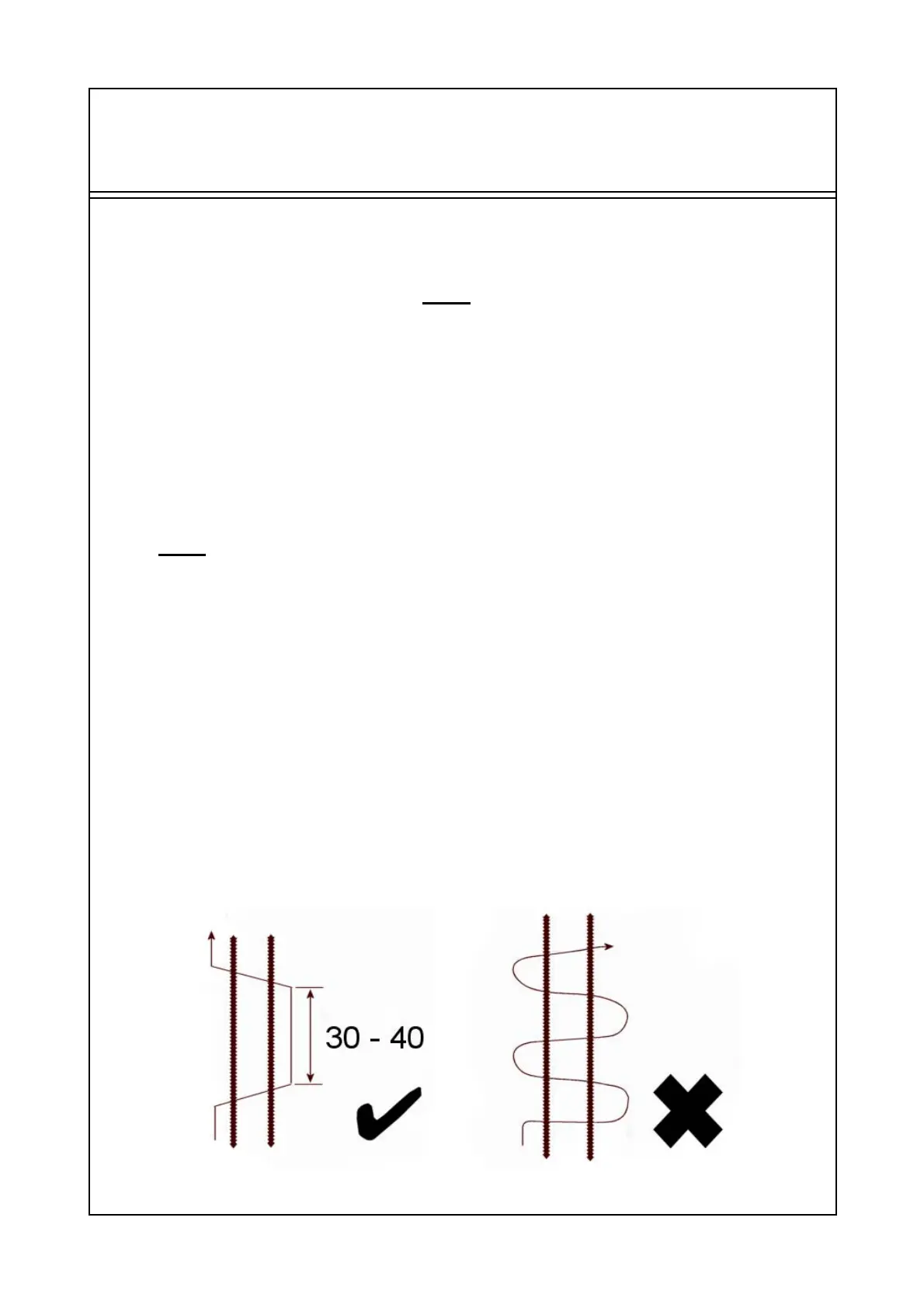
In the case where narrower swaths are unavoidable it is recommended that the
swath be periodically directed 30 – 40 m to the right hand side and also the same
distance to the left hand side of the pick-up as the baler is driven over the swath,
see figure 9.2.1.
Collect the material into one side of the pick-up for 6 to 8 seconds. Then cross
over the windrow and collect material for the same duration. Reduce the length of
time for heavy windrows and increase for lighter windrows.
Continuous weaving is not recommended as this will result in excessive
material being placed towards the centre of the bale, see figure 9.2.2.
In the case of wider swaths i.e. >1.5 m; this size of windrow should be avoided,
as in this case a greater amount of material will continue to be fed to the outside of
the baler. As a result, a greater amount of material will be fed to the outer edges of
the bale than to the centre. This will result in concave-shaped bales.
Fig. 9.2.1. Fig. 9.2.2.
m



 To Next Page