MOOR INSTRUMENTS moorLDI2 RESEARCH USER MANUAL
33
4. THE LASER DOPPLER TECHNIQUE
4.1 INTRODUCTION
The laser Doppler technique was first applied to monitoring tissue blood flow by Stern et al in 1975.
Since then it has been applied to most branches of medicine and physiology.
There are two basic types of laser Doppler device: the laser Doppler perfusion monitor and the laser
Doppler perfusion imager. The monitor usually employs optical fibre light guides to transmit light to
the tissue and back to a detector for processing. Tissue contact is usually necessary with monitoring
and a wide variety of probes enable access to most tissues for continuous monitoring. Laser Doppler
imaging does not involve tissue contact.
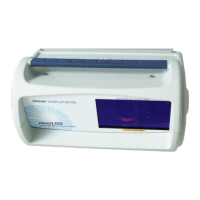
The moorLDI2 has a fast scanning mode and the ability to function in ambient lighting. Further
features are: non-contact measurement, high resolution imaging, a large scan range and user friendly
Windows
software for acquisition, display, image processing and analysis.
4.2 SPATIAL VARIATION OF PERFUSION
There can be considerable spatial heterogenity of blood flow across a tissue surface and this can
change following stimulus or with pathology. The distribution of perfusion also evolves with time
and it is for this reason that the moorLDI2 high speed, high resolution laser Doppler imager was
developed.
4.3 PRINCIPLES OF THE LASER DOPPLER IMAGING TECHNIQUE
Low power laser light is directed via a moving mirror to execute a raster pattern across the tissue
surface. The depth of tissue probed by the moorLD2 is tissue dependent and influenced by
pigmentation. For skin it can be assumed that full dermal thickness is probed by both red and infra-
red wavelengths. However, the infra-red wavelength will give a higher weighting to blood flow in the
deeper dermis. An advantage of the infra-red wavelength is that it is not strongly attenuated by dark
skin. This can lead to loss of image with the red wavelength.
The incident light is scattered by static tissue and by moving blood. The Doppler shifted light from
moving blood and the non-shifted light from tissue is then directed by the same moving mirror (and
other optics) onto two square-law detectors.
Light 'beats' at the detectors due to constructive and destructive mixing of the light. These intensity
fluctuations are then processed to give parameters of flux (proportional to tissue blood flow) and
conc (proportional to the concentration of moving blood cells).
Tissue blood flow varies with temperature and so it can be important to standardise conditions,
including a period of acclimatisation, in any measurement protocol. Absence of blood flow during
occlusion does not lead to zero laser Doppler flux values. This 'biological zero' effect is due to
residual interstitial movement and in some cases of ischaemia it may be necessary to subtract this
from values obtained. Under some low flow conditions it might be necessary to reduce scan speed to
obtain the flux resolution required.


 To Next Page