8. Tyre manufacturing standard
information, which can be used for tyre
recalls and other checking processes.
Most of this information relates to the
manufacturer, place of manufacture,
etc. The last four numbers are the date
of manufacture. For example, if the
number was 3106, the tyre was made
in the 31st week of 2006.
9. M+S or M/S indicates that the tyre has
been designed with some capability
for mud and snow.
10.The number of plies in both the tread
area and the sidewall area, indicates
how many layers of rubber-coated
material make up the structure of the
tyre. Information is also provided on
the type of materials used.
11.Wear rate indicator: A tyre rated at
400, for example, will last twice as long
as a tyre rated at 200.
12.The traction rating grades a tyre's
performance when stopping on a wet
road surface. The higher the grade,
the better the braking performance.
The grades, from highest to lowest are;
AA, A, B, and C.
The traction grade assigned to
this tyre is based on
straight-ahead braking traction
tests and does not include
acceleration, cornering,
hydroplaning, or peak traction
characteristics.
13.The maximum load which can be
carried by the tyre.
14.Heat resistance grading: The tyres
resistance to heat is grade A, B, or C,
with A indicating the greatest
resistance to heat. This grading is
provided for a correctly inflated tyre,
which is being used within its speed
and loading limits.
15.The maximum inflation pressure for
the tyre. This pressure should not be
used for normal driving. See 240,
AVOIDING FLAT SPOTS.
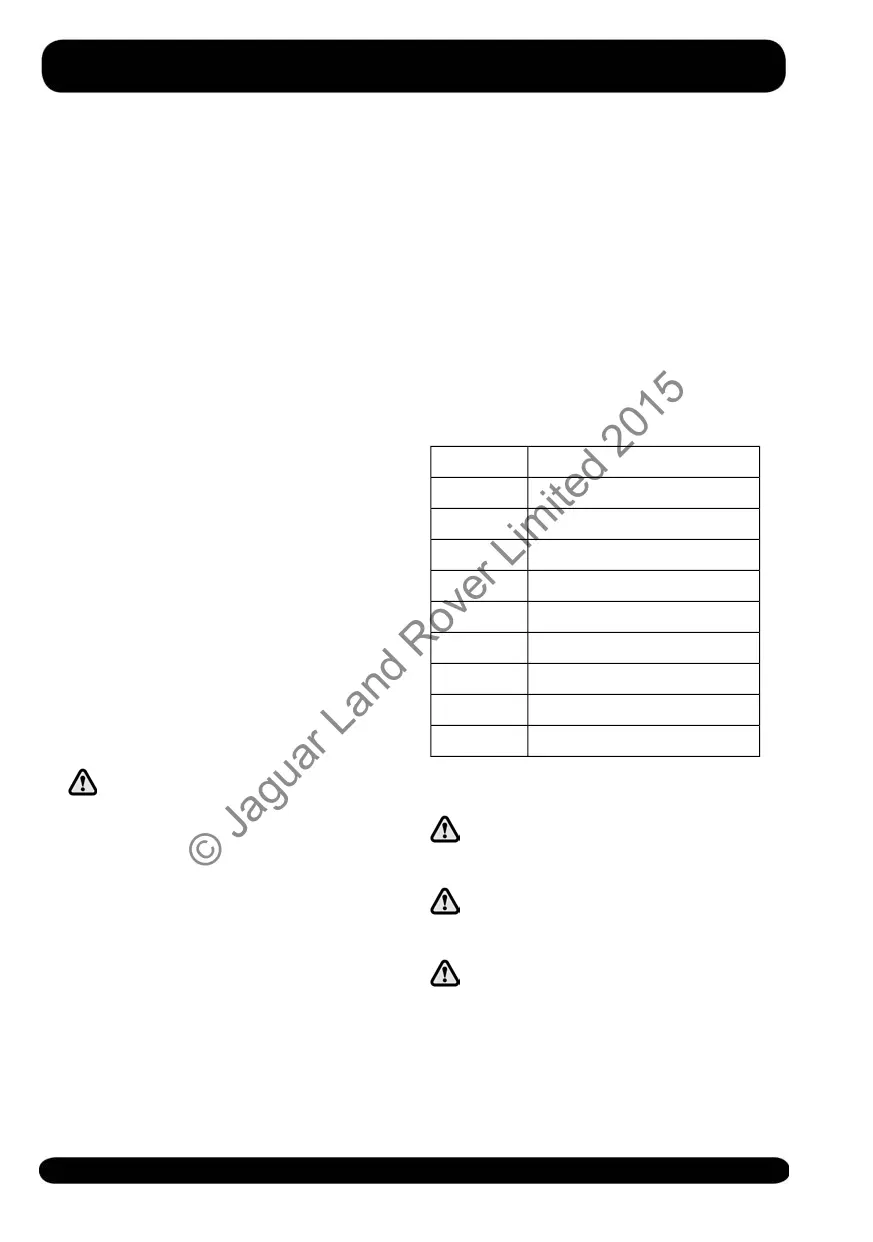
SPEED RATING
Speed km/h (mph)Rating
160 (99)Q
170 (106)R
180 (112)S
190 (118)T
200 (124)U
210 (130)H
240 (149)V
270 (168)W
300 (186)Y
TYRE CARE
Do not drive the vehicle if a tyre
is damaged, excessively worn, or
incorrectly inflated.
Avoid contaminating the tyres
with vehicle fluids, as they may
cause damage to the tyre.
Avoid spinning the wheels. The
forces released can damage the
structure of the tyre, and cause it
to fail.
236
Tyres
© Jaguar Land Rover Limited 2015



 To Next Page