S3F84B8_UM_REV 1.00 2 ADDRESS SPACES
2-17
2.4.3 8-BIT WORKING REGISTER ADDRESSING
You can also use 8-bit working register addressing to access registers in a selected working register area. To
initiate 8-bit working register addressing, the upper four bits of the instruction address must contain the value
“1100B.” This 4-bit value (1100B) indicates that the remaining four bits have the same effect as 4-bit working
register addressing.
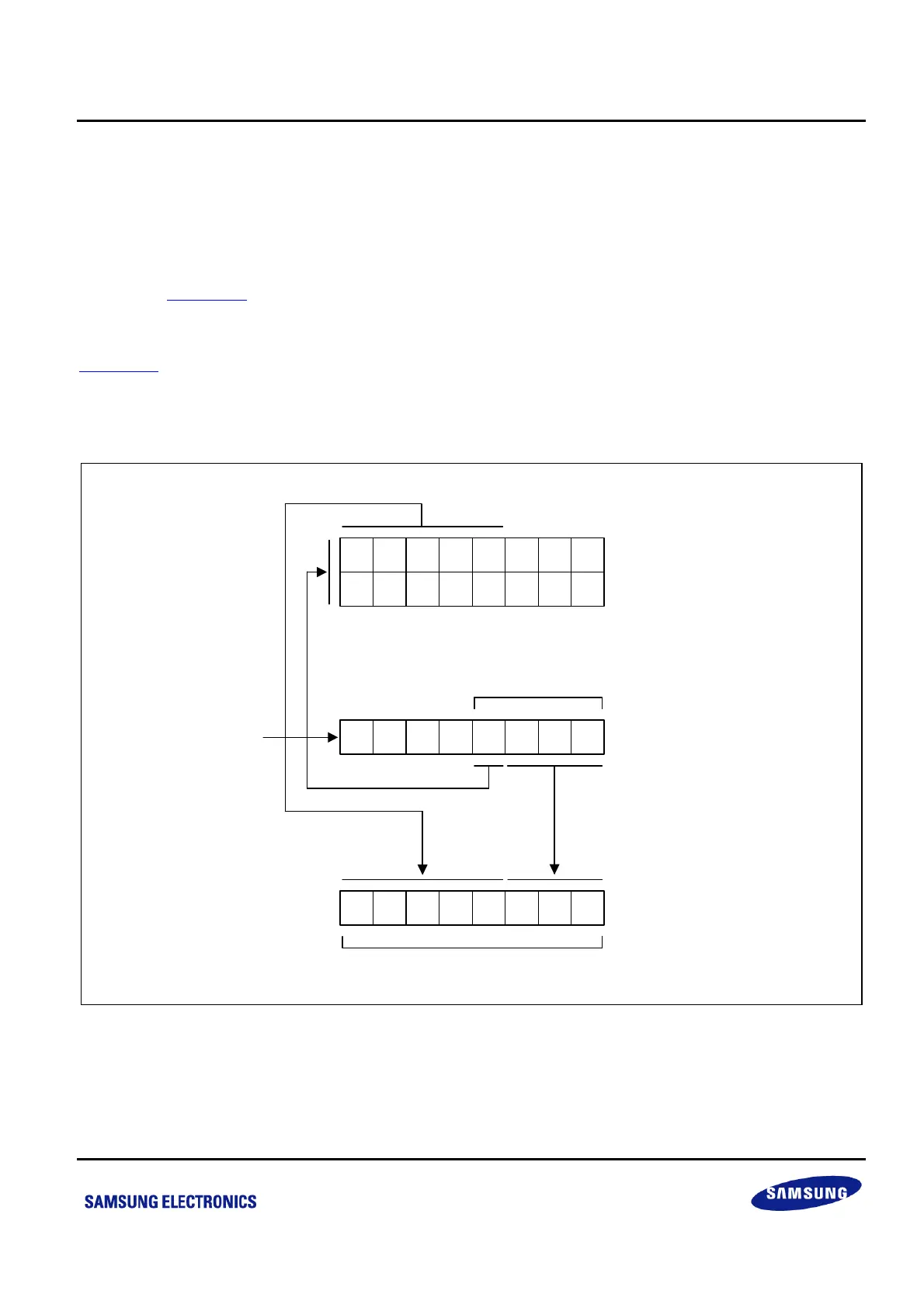
As shown in Figure 2-14
, the lower nibble of 8-bit address is concatenated in the same way as 4-bit addressing:
Bit 3 selects either RP0 or RP1, which then supplies the five high-order bits of final address; the three low-order
bits of complete address are provided by the original instruction.
Figure 2-15
shows an example of 8-bit working register addressing. The four high-order bits of instruction address
(1100B) specify the 8-bit working register addressing. Bit 4 (“1”) selects RP1, and the five high-order bits in RP1
(10101B) become the five high-order bits of register address. The three low-order bits of register address (011)
are provided by the three low-order bits of 8-bit instruction address. The five address bits from RP1 and three
address bits from instruction are concatenated to form the complete register address, 0ABH (10101011B).
8-bit logical
address
8-bit physical address
Register pointer
provides five
high-order bits
Address
Selects
RP0 or RP1
RP1
RP0
Three low-order bits
These address
bits indicate 8-bit
working register
addressing
1100
Figure 2-14 8-Bit Working Register Addressing



 To Next Page