De-energized Switching
Connecting two components of a power system is also possible if at least one of the components is de-ener-
gized and if the measured voltage is greater than the threshold 6106 V>. With a multi-phase connection on
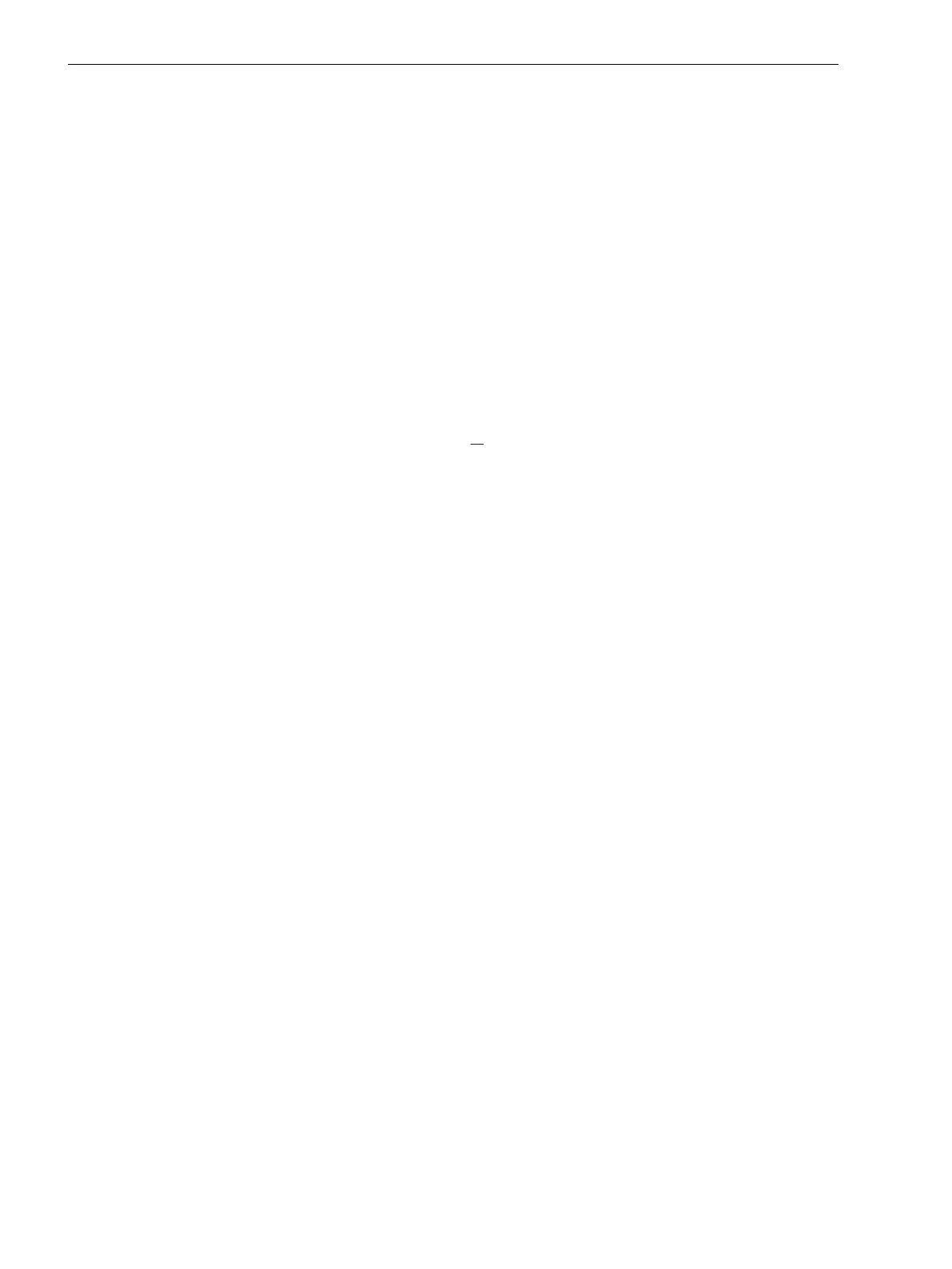
the side V
1
, all connected voltages must have a higher value than the threshold V> so that the side V
1
is
considered as being energized. With a single-phase connection, of course, only the one voltage has to exceed
the threshold value.
Besides the release under synchronous conditions, the following additional release conditions can be selected
for the check:
SYNC V1>V2< = Release on the condition that component V
1
is energized and component V
2
is de-
energized.
SYNC V1<V2> = Release on the condition that component V
1
is de-energized and component V
2
is
energized.
SYNC V1<V2< = Release on the condition that component V
1
and component V
2
are de-energized.
Each of these conditions can be enabled or disabled individually via parameters or binary inputs; combinations
are thus also possible (e.g. release if SYNC V1>V2< or SYNC V1<V2> are fulfilled).
For that reason synchronization with the use of the additional parameter 6113 25 Synchron (configured to
NO) can also be used for the connection of a ground electrode. In such a case, connection is only permissible
when there is no voltage on the load side.
The threshold below which a power system component is considered as being de-energized is defined by
parameter V<. If the measured voltage exceeds the threshold V>, a power system component is considered as
being energized. With a multi-phase connection on the side V
1
, all connected voltages must have a higher
value than the threshold V> so that the side V
1
is considered as being energized. With a single-phase connec-
tion, of course, only the one voltage has to exceed the threshold value.
Before granting a release for connecting the energized component V
1
and the de-energized component V
2
,
the following conditions are checked:
•
Is the reference voltage V
1
above the setting value Vmin and V> but below the maximum voltage Vmax?
•
Is the voltage to be synchronized V
2
below the setting value V<?
•
Is the frequency f
1
within the permissible operating range f
Nom
± 3 Hz?
After successful completion of the checks, the release is granted.
For connecting the de-energized component 1 to the energized component 2 or the de-energized component
1 to the de-energized component 2, the conditions to be fulfilled correspond to those stated above.
The associated messages indicating the release via the corresponding condition are as follows:
25 V1> V2<
,
25 V1< V2>
and
25 V1< V2<
.
Via the binary inputs
>25 V1>V2<
,
>25 V1<V2>
and
>25 V1<V2<
, the release conditions can also be issued
externally, provided the synchronization is controlled externally.
The parameter TSUP VOLTAGE (address 6111) can be set to configure a monitoring time which requires the
additional release conditions stated above to be present for de-energized connection before connection is
allowed.
Direct Command / Blocking
Parameter 6110 Direct CO can be set to grant a release without performing any checks. In this case,
connection is allowed immediately when initiating the synchrocheck function. It is obviously not reasonable to
combine Direct CO with other release conditions.
If the synchrocheck function fails, a direct command may be issued or not, depending on the type of failure
(also see “Plausibility Check” and “SYNC Error”).
Via the binary input
>25direct CO
, this release can also be granted externally.
2.20.3
2.20.4
Functions
2.20 Synchrocheck
340 SIPROTEC Compact, 7SC80, Manual
E50417-G1140-C486-A8, Edition 07.2017



 To Next Page