Automatic Reclosing by Protection Functions" and "Controlling Overcurrent Protection Elements via Cold Load
Pickup") can thus be set to determine which protection elements are active or blocked during which dead time
cycles for multiple reclosing attempts of downstream devices.
In the example shown in Figure "Zone sequencing with a fault occurring at Tap Line 5 and the busbar" (see
Figure 2-99) in the functional description, the zone sequencing was applied in the bus relay. Furthermore, as
from the second automatic reclosure, the 50-2 elements (also applicable to the 50-3 elements) must be
blocked, i.e. address 7214 bef.2.Cy:50-2 must be set to blocked T=∞. The zone sequencing of the
feeder relays is switched off but the 50-2 elements must also be blocked after the second reclosing attempt.
Moreover, it must be ensured that the 50-2 elements start the automatic reclosing function: Set address 7152
50-2 to Starts 79.
All settings of the 50-2 and 50-3 elements mentioned here apply analogously to the 50N-2 and 50N-3
elements.
Controlling Overcurrent Protection Stages via Cold Load Pickup
The dynamic cold load pickup function provides a further alternative to control the protection via the auto-
matic reclosing function (see also Section 2.4 Dynamic Cold Load Pickup). This function contains the param-
eter 1702 Start Condition. It determines the starting conditions for the increased setting values of
current and time of the dynamic cold load pickup that must apply for directional and non-directional overcur-
rent protection.
If address 1702 Start Condition = 79 ready, the overcurrent protection always employs the increased
setting values if the automatic reclosing system is ready. The auto-reclosure function provides the signal 79
ready for controlling the cold load pickup. The signal 79 ready is always active if the auto-reclosing system
is available, active, unblocked and ready for another cycle. Control via the cold load pickup function is not
ARcycle- related.
Since control via cold load pickup and cyclic control via auto-reclosing system can run simultaneously, the
overcurrent protection must coordinate the input values of the two interfaces. In this context the cyclic auto-
reclosing control has the priority and thus overwrites the release of the cold load pickup function.
If the protective elements are controlled via the automatic reclosure function, changing the control variables
(e.g. by blocking) has no effect on elements that are already running. The elements in question are continued.
Note Regarding Settings List for Automatic Reclosure Function
The setting options of address 7137 Cmd.via control are generated dynamically according to the current
configuration.
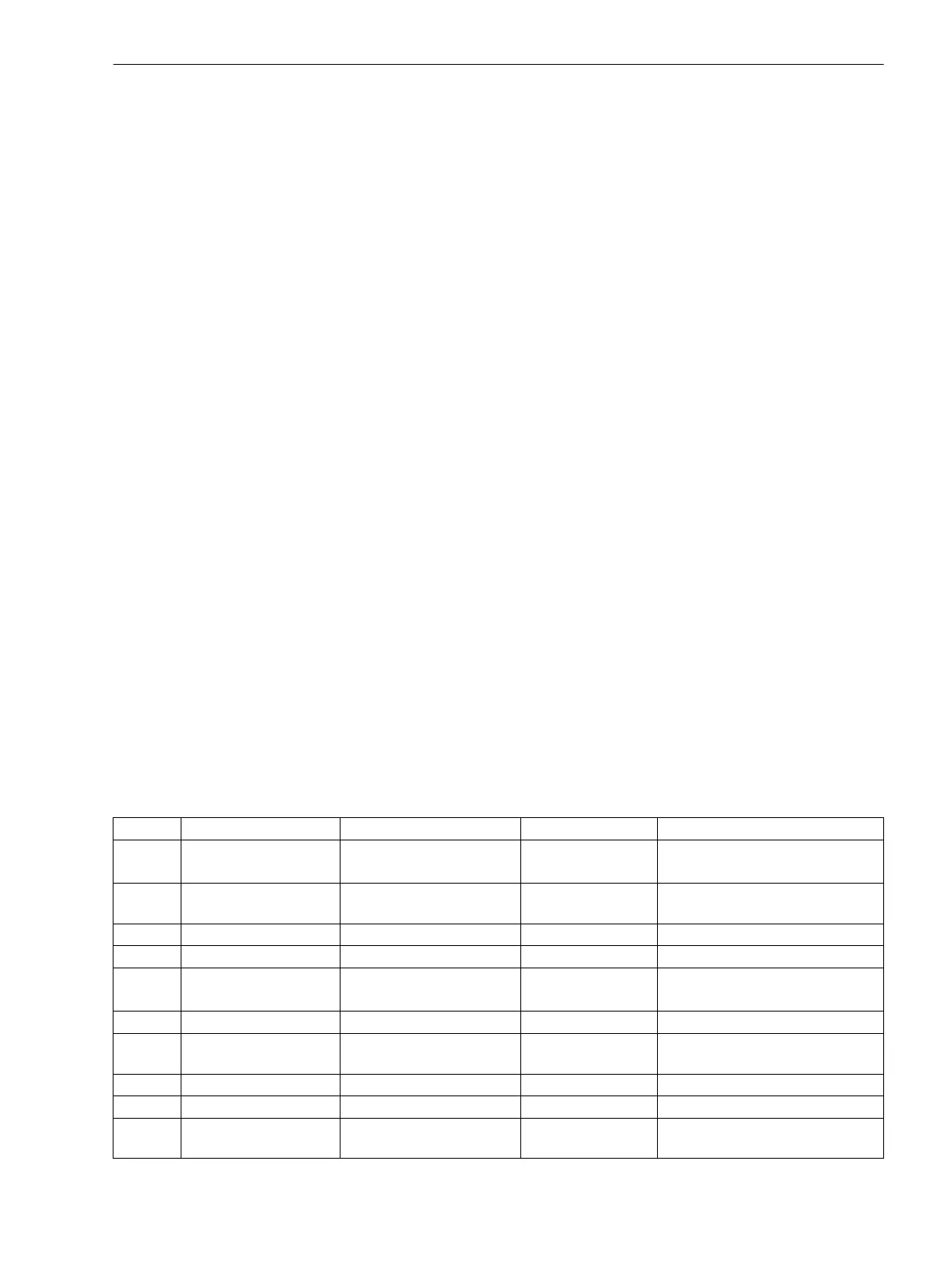
Settings
Addr.
Parameter Setting Options Default Setting Comments
7101 FCT 79 OFF
ON
OFF 79 Auto-Reclose Function
7103 BLOCK MC Dur. 0.50 .. 320.00 sec; 0 1.00 sec AR blocking duration after manual
close
7105 TIME RESTRAINT 0.50 .. 320.00 sec 3.00 sec 79 Auto Reclosing reset time
7108 SAFETY 79 ready 0.01 .. 320.00 sec 0.50 sec Safety Time until 79 is ready
7113 CHECK CB? No check
Chk each cycle
No check Check circuit breaker before AR?
7114 T-Start MONITOR 0.01 .. 320.00 sec; ∞ 0.50 sec AR start-signal monitoring time
7115 CB TIME OUT 0.10 .. 320.00 sec 3.00 sec Circuit Breaker (CB) Supervision
Time
7116 Max. DEAD EXT. 0.50 .. 1800.00 sec; ∞ 100.00 sec Maximum dead time extension
7117 T-ACTION 0.01 .. 320.00 sec; ∞ ∞ sec Action time
7118 T DEAD DELAY 0.0 .. 1800.0 sec; ∞ 1.0 sec Maximum Time Delay of Dead-
Time Start
2.14.7
Functions
2.14 Automatic Reclosing System 79
SIPROTEC Compact, 7SC80, Manual 283
E50417-G1140-C486-A8, Edition 07.2017



 To Next Page