CHAPTER 11 Technical Information
Sysmex XE-5000 Instructions for Use 11-11
Revised April 2007
11.5 Principles
1. Detection principle
This instrument performs hematology analysis according to
the RF/DC detection method, Hydro Dynamic Focusing (DC
Detection), flow cytometry method (using a semiconductor
laser), and SLS-hemoglobin method.
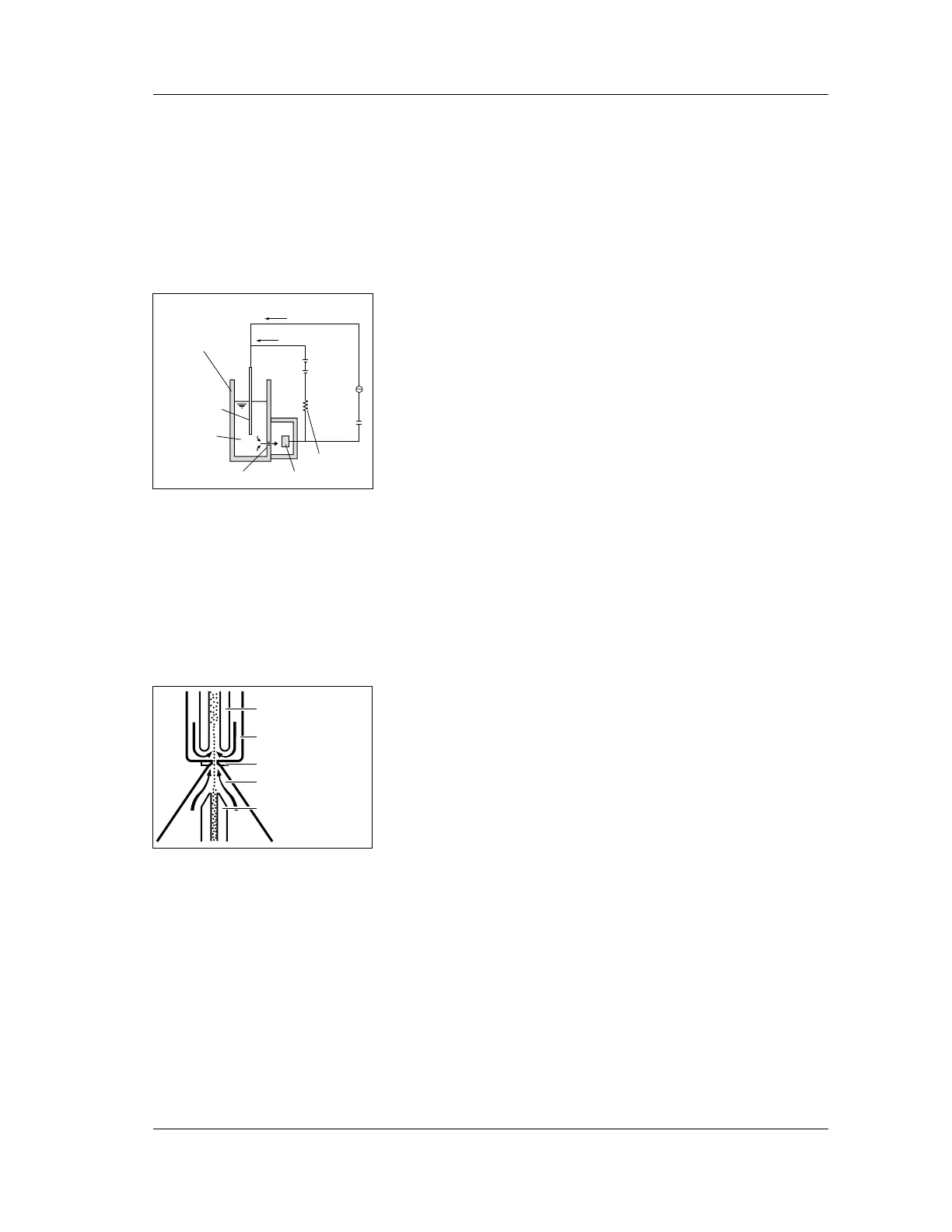
RF/DC detection method
The RF/DC detection method detects the size of blood cells
by changes in direct-current resistance, and the density of the
blood cell interior by changes in radio-frequency resistance.
A blood sample is aspirated and measured, diluted to the
specified ratio, and sent to the applicable detector chamber.
Inside the detector chamber is a tiny hole called an “aperture”,
on both sides of which are electrodes. Between the
electrodes flow direct current and radio-frequency current.
Blood cells suspended in the IMI reagent pass through the
aperture, changing the direct-current resistance and
radio-frequency resistance between the electrodes. The size
of the blood cells is detected via changes in the direct-current
resistance and the density of the blood cell interior (size of the
nucleus and other information) is detected via changes in the
radio-frequency resistance, with such detection coming in the
form of electrical pulses. Based on the size of these pulses, a
two-dimensional distribution (scattergram) of the blood-cell
size and internal density can be drawn. Various analysis data
can be obtained by analyzing such distributions (scattergram).
Hydro dynamic focusing (DC Detection)
Inside the detector, the sample nozzle is positioned in front of
the aperture and in line with the center. After diluted sample is
forced from the sample nozzle into the conical chamber, it is
surrounded by front sheath reagent and passes through the
aperture center.
After passing through the aperture, the diluted sample is
surrounded by back sheath reagent and sent to the recovery
tube. This prevents the blood cells in this area from drifting
back, and prevents the generation of false platelet pulses. The
Hydro Dynamic Focusing method improves blood count
accuracy and reproducibility. Because the blood cells pass
through the aperture in a line, also generation of artifical
pulses (interference) is prevented. Hydro Dynamic Focusing
method improves the blood count accuracy and reproducibility
by minimizing the coincidence error.
Radio-frequency
current
Direct current
Detector chamber
RF current
source
Resistance
External
electrode (+)
Capacitor
Internal electrode (-)Aperture
DC source
Cell
suspension
Recovery tube
Back sheath reagent
Aperture
Front sheath reagent
Sample nozzle


 To Next Page