Operation
0820−1/A1
Winterthur Gas & Diesel Ltd.
3/ 7
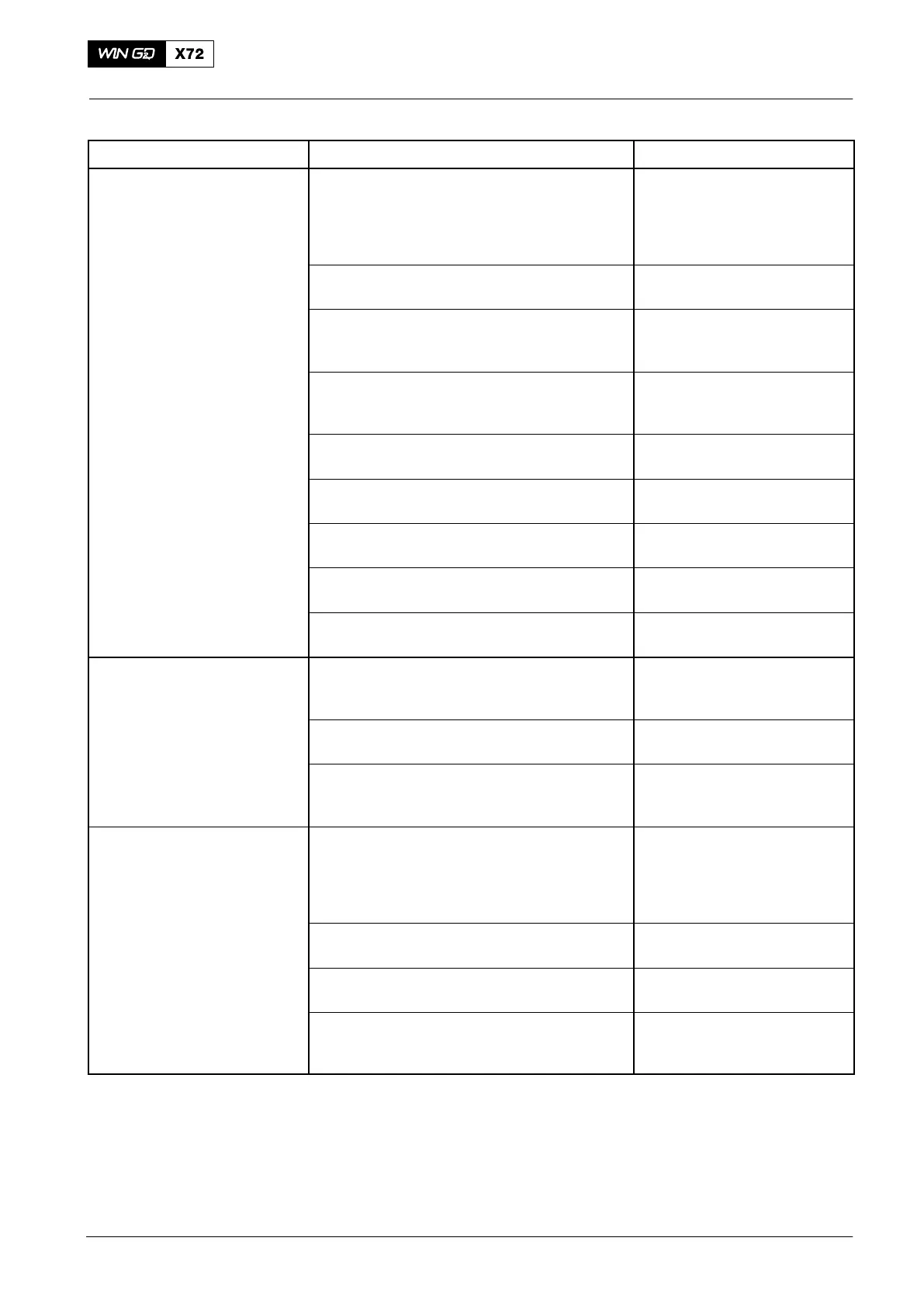
Problem Possible Causes Procedure
There is smoke from the
exhaust
Air supply is not sufficient. Unwanted material
in: the exhaust side or air side of the
turbocharger, scavenge air cooler, air flaps in
the receiver, scavenge ports in cylinder liners
or in the exhaust boiler
See Scavenge air pressure
decreases
The engine has too much load Decrease the fuel injection
quantity
The engine operates with too much cylinder
lubricating oil
See 7218−1, paragraph 6.4
Adjustment − lubricating oil
feed rate
Injection nozzles do not completely change
the fuel into a spray, e.g. because there
trumpets, worn or blocked spray holes
Clean the parts. Do a check
to adjust the parts, or replace
the parts
The fuel is incorrect, or the viscosity is too
high (not not sufficiently heated)
See 0270−1 paragraph 2
The compression pressure too low. The
piston rings have leaks, exhaust valve leaks
Replace the piston rings,
grind the valve seat and head
Bores in upper housing of the exhaust valve
are clogged. Exhaust valves close too late
Do a check and clean the
parts
The servo oil pressure is too low, the servo
oil pump control is defective, oil leakage
Do a check of the oil flow.
Find and repair the leaks
An auxiliary blower operates at part load, or
the two auxiliary blowers do no operate.
Set the auxiliary blowers to on
Engine operates irregularly or
misfires at times, on one or all
cylinders
There is high water quantity in the fuel See 0720−1, paragraph 2
Treatment of HFO and
treatment plant
The fuel temperature upstream of the fuel
pumps is too low or too high
See 0270−1, paragraph 2
The pressure in the fuel rail is too low. The
pressure control valve is defective. One of
the fuel pumps does not supply fuel
See 0515−1, paragraph 5. Do
a check of the pressure
transmitter.
The engine stops without
operator input (without a
shut-down indication)
The fuel daily tank is empty, or fuel supply is
stopped. The fuel filters are blocked. The
booster pump is defective. Defective
switching. The fuel rail pressure is too low.
The fuel system leaks.
Fill the daily tank. Clean the
filter. Find other causes and
repair the defects. Find and
repair leaks.
There is no electrical power supply to the
engine control system (ECS)
Repair the cause and start
the ECS
The speed setting system is defective, e.g.
broken cables
Repair the fault
The engine stops in heavy sea Set the Heavy Sea Mode to
on (see 4002−2, paragraph
3.10 User parameters)
2014
Irregular Operation


 To Next Page