Operation
3140−1/A1
Winterthur Gas & Diesel Ltd.
1/ 2
Axial Damper
1. General
The engine has a built-in axial damper. The function of the axial damper is to
decrease the axial vibrations.
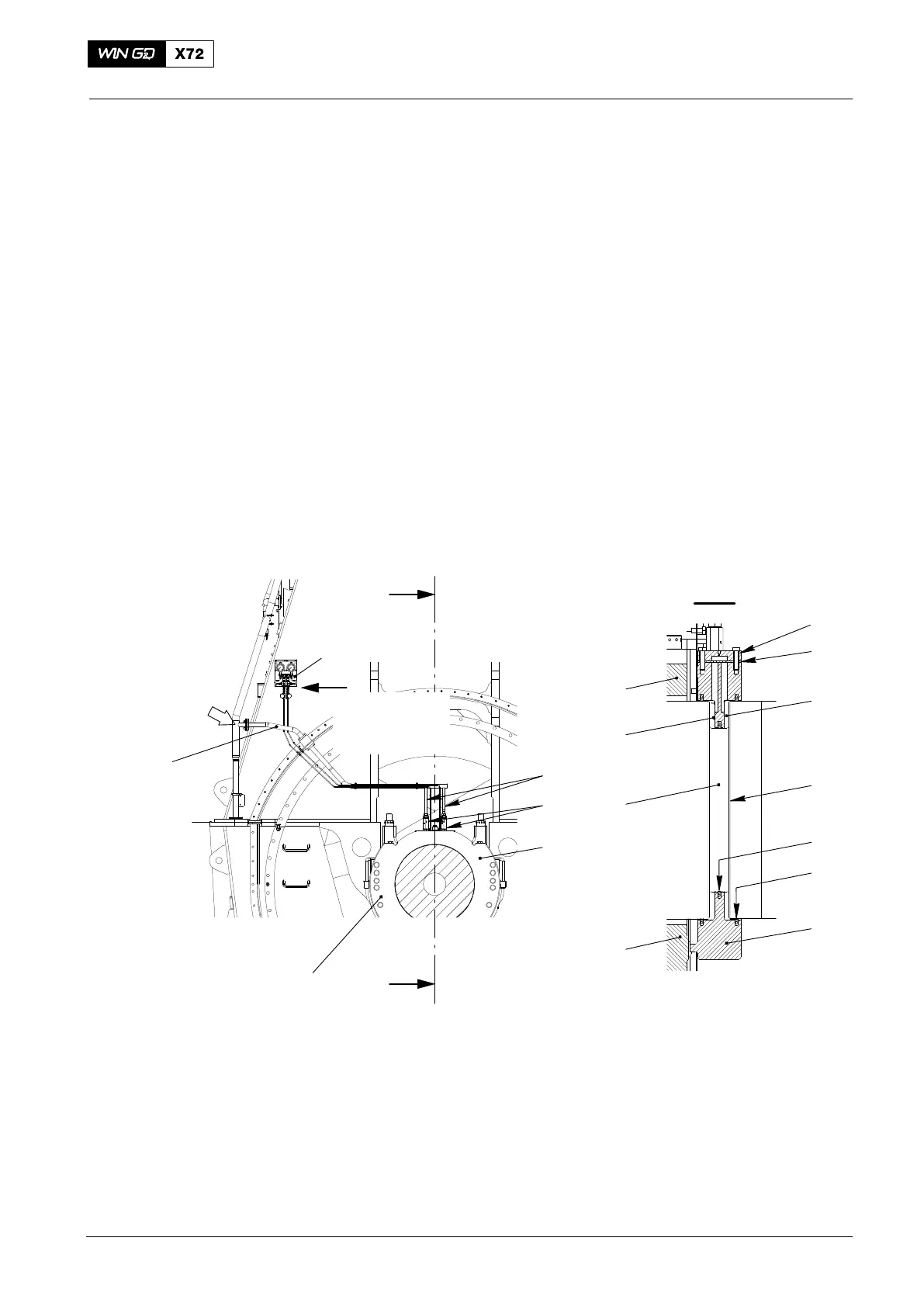
The axial damper includes a top cylinder half (3, Fig. 1) and a bottom cylinder half (4)
attached with bolts to the last bearing girder.
2. Function
Bearing oil flows from the oil inlet (OI) through the oil pipe (5) into the two inlet pipes
(1). The bearing oil then flows through the non-return valves (2) into the groove in the
crankshaft (10) (i.e. into the annular spaces (9) on each side of the middle part of the
cylinder halves (3) and (4)).
Most of the oil can only flow through the pressure reducing nozzle (7) from one
annular space (9) to the other when the crankshaft turns.
The remaining oil drains because of the radial and axial clearances of the sealing
rings (11) and (12) and the vent bore in the pressure reducing nozzle (7).
Note: Do not operate the engine when there is no oil supply to the axial damper.
7
8
10
9
9
15
11
12
13
14
16
WCH01218
I - I
OI
I
I
5
6
1
2
3
4
WCH01218
II
For View II
see Fig. 2
Fig. 1: Axial Damper
1 Inlet pipes 10 Groove in crankshaft
2 Non-return valves 11 Large sealing ring
3 Top cylinder half 12 Small sealing ring
4 Bottom cylinder half 13 Vibration damper
5 Oil pipe 14 Bearing girder (part of bedplate)
6 Axial damper monitor 15 Crankshaft
7 Pressure reducing nozzle 16 Bearing cover
8 Orifice
9 Annular space OI Oil inlet
2014


 To Next Page