1-10 Preventive Maintenance Chapter 1 — General Information
1-14 MS20xxA VNA Master UG 10580-00166 Rev. C
1-10 Preventive Maintenance
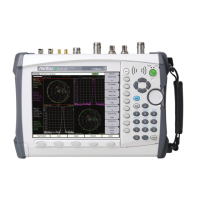
VNA Master preventive maintenance consists of cleaning the unit and inspecting and
cleaning the RF connector on the instrument and all accessories. Clean the VNA Master with
a soft, lint-free cloth dampened with water or water and a mild cleaning solution.
Clean the RF connectors and center pins with a cotton swab dampened with denatured
alcohol. Visually inspect the connectors. The fingers of N(f) connectors and the pins of N(m)
connectors should be unbroken and uniform in appearance. If you are unsure whether the
connectors are good, then gauge the connectors to confirm that their dimensions are correct.
Visually inspect the test port cable(s). The test port cable should be uniform in appearance,
not stretched, kinked, dented, or broken.
1-11 Calibration Requirements – Vector Network Analyzer
The VNA Master is a field portable unit operating in the rigors of the test environment. An
Open-Short-Load (OSL) or Open-Short-Load-Through (OSLT) calibration should be
performed prior to making a measurement in the field.
The VNA Master has no field-adjustable components. The OSL calibration components,
however, are crucial to the integrity of the calibration and should be periodically verified to
ensure performance. This is especially important if the components have been dropped or
over-torqued.
1-12 Calibration Requirements – Spectrum Analyzer
The VNA Master loads factory calibration data during start-up, eliminating the need for daily
calibration checks.
1-13 Annual Verification
Anritsu recommends an annual calibration and performance verification of the VNA Master
and the calibration components by local Anritsu service centers. Anritsu service centers are
listed our web site at www.anritsu.com.
CAUTION: To avoid damaging the display or case, do not use solvents or abrasive
cleaners.
Note
For best calibration results (compensation for all measurement uncertainties), ensure
that the calibration is performed at the end of the test port or optional extension cable;
that is, at the same point that the device that is to be tested will be connected.
Note
For best results, use an Anritsu phase stable Test Port Extension Cable. Use of a
typical laboratory cable to extend the VNA Master test port to the device under test, or
any cable bending subsequent to the OSL or OSLT calibration, may cause
uncompensated phase reflections inside the cable. These reflections will cause
measurement errors that will be more pronounced at higher frequencies.
10580-00166C.book Page 14 Thursday, February 21, 2008 12:52 PM






 To Next Page