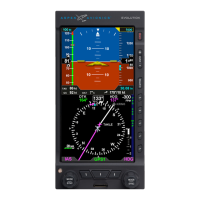
EFD1000 PFD Pilot’s Guide
CHAPTER 4, REFERENCE GUIDE
EFD1000 PFD Pilot’s Guide
EFD1000 PFD Pilot’s Guide Page 4-25A-01-184-00 REV B
4.3.5. CDI Navigation Source
When the EFD1000 PFD powers up, the default CDI Navigation Source is the last
selected or the rst congured navigation source, if no previous selection was made.
The pilot can select from any of the installed navigation sources, using the bottom
center button. The EFD1000 PFD supports navigation information display from VHF
Omni-directional Radio Range (VOR) navaids, Localizers (LOC), Glide Slope receivers
(GS), and Global Positioning Systems (GPS). There can be up to four dedicated, two
integrated, or a combination of one integrated and two dedicated navigation systems
installed (Table 4-3).
INSTALLED NAVIGATION SOURCES CDI
LABEL
POSSIBLE
CONFIGURATION
Dedicated NAV VHF Radio System VLOC1 x x
Dedicated NAV VHF Radio System VLOC2 x x
Dedicated Global Positioning System GPS1 x x
Dedicated Global Positioning System GPS2 x x
Integrated
System 1
GPS/VHF NAV Radio System
GPS selected or
GPS1 or
x x
GPS/VHF NAV Radio System
VHF NAV selected
VLOC1
Integrated
System 2
GPS/VHF NAV Radio System
GPS selected or
GPS2 or
x x
GPS/VHF NAV Radio System
VHF NAV selected
VLOC2
NOTE
For integrated systems, the CDI
navigation source label indicates the
current operating mode (“GPS” or
“VLOC”) of the GPS/VHF NAV system.
When an integrated system is selected,
but not reporting its operating mode,
the label VLOC# displays.
Refer to the GPS or VHF NAV AFMS for
information on the operation of the
connected navigation equipment.
Table 4-3 Possible CDI Navigation Source Conguration
NOTE
There are many radio congurations
available. Your authorized Aspen
Avionics Dealer can tell you the
conguration used on your aircraft.


 To Next Page