EFD1000 PFD Pilot’s Guide
CHAPTER 2, CONTROLS AND DISPLAY
EFD1000 PFD Pilot’s Guide
EFD1000 PFD Pilot’s Guide Page 2-29A-01-184-00 REV B
2.3.3.1. Horizontal Situation Indicator (HSI)
The traditional HSI is an instrument that combines a slaved magnetic Heading
Indicator overlaid with a rotating Course Pointer and Deviation Indicator (CDI). This
combination has also been called a pictorial navigation indicator, because it helps the
pilot better visualize the aircraft position relative to its desired course. The HSI is a vast
improvement over the older, separate Directional Gyro (DG) and OBS course deviation
indicator, because the compass heading is always correct (slaved to a remote magnetic
ux detector), and integration of the CDI onto the compass simplies the instrument
scan and provides better situational awareness.
Pilots experienced with mechanical HSIs will nd the 360º mode of the EFD1000
Navigation Display immediately familiar. In its basic form, it is just an electronic
representation of a mechanical HSI. Pilots transitioning from ying a DG and OBS
should get some dual instruction from a CFII on the dierences in ying an HSI, because
some instrument ying techniques dier from what they may be used to.
Compass Modes: 360º vs. ARC
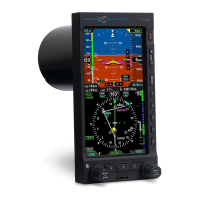
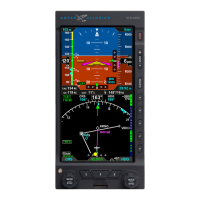
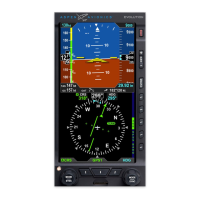
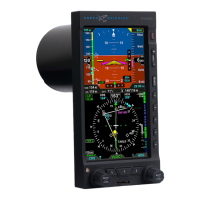
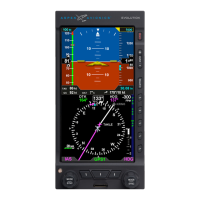
The HSI on the EFD1000 can be presented in either a full 360º compass rose mode
(shown in Figure 2-35), or in a 100º ARC format (Figure 2-36). In 360 Mode, the HSI
resembles the mechanical instrument, with the ownship position in the center of the
display. ARC Mode provides an extended forward view with the ownship position at
the bottom of the display. The ARC mode is especially good for map displays. The
middle Hot Key is used to toggle the display between 360 and ARC modes, with the
current mode shown in green adjacent to the Hot Key.
Figure 2-36
ARC CDI Mode with Base Map


 To Next Page