CHAPTER 2, CONTROLS AND DISPLAY
EFD1000 PFD Pilot’s Guide
Page 2-34 A-01-184-00 REV B
EFD1000 PFD Pilot’s Guide
EFD1000 PFD Pilot’s Guide
information about the source of the bearing pointer data. Information that can be
displayed includes distance to station (if coupled to a GPS waypoint) and either the
station identier or the tuned frequency for a VLOC radio. This information is only
presented when it is reported to the EFD1000 by the connected equipment, and thus is
not available in all installations.
2.3.3.5. Situational Awareness Map Display
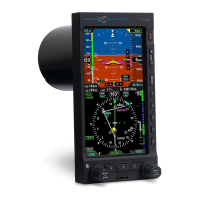
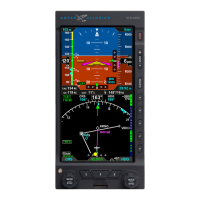
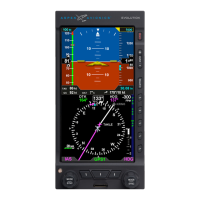
When the EFD1000 is connected to a compatible GPS navigator, a base map can be
displayed underneath the HSI in either 360º or ARC modes. Most GPS put out data to
enable the EFD1000 to display the active GPS ight plan legs and waypoints. The active
GPS ight plan leg, waypoint, and its identier are shown in magenta. Other waypoints
and legs are shown in white.
Some GPS navigators (typically those using the ARINC 429 data protocol, such as the
Garmin 400/500 series) additionally put out information on nearby nav data waypoints
(e.g., airports, VORs, NDBs and intersections), which can also be displayed on the
EFD1000 base map. These GPS can often also display curved ight paths, such as
course reversals and holding patterns.
The base map is always oriented with magnetic heading up and centered so that the
current aircraft position coincides with the aircraft ownship symbol. These base map
elements underlay all other instruments and annunciations in the Navigation Display.
The MAP hot key is used to cycle through four levels of map features display and to turn


 To Next Page