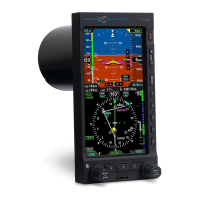
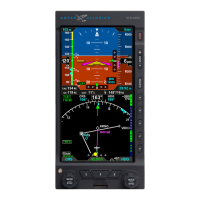
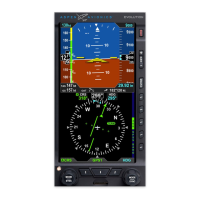
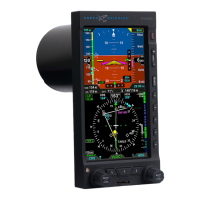
EFD1000 PFD Pilot’s Guide
CHAPTER 4, REFERENCE GUIDE
EFD1000 PFD Pilot’s Guide
EFD1000 PFD Pilot’s Guide Page 4-43A-01-184-00 REV B
4.4.2. Vertical Deviation Indicator
The Vertical Deviation Indicator (VDI) is enabled on the attitude indicator when the
active navigation source is a VHF navigation radio, the ILS mode is active, and a valid
localizer signal is being received. The VDI is also displayed for a GPS, supplying valid
vertical deviation data, when in the approach mode. When the vertical deviation
exceeds the displayable range of 2.5 dots, the course deviation diamond becomes dim
and hollow, and is “parked” at the extreme edge of the VDI scale (Figure 4-96).
4.5. Vertical Speed Indicator
When the 360° compass is used, the Vertical Speed Indicator (VSI) is rendered, on the
right side of the Navigation Display, showing a digital and graphical representation of
vertical speed. The VSI indicates non-barometric change in pressure altitude over time.
The graphical display is a white vertical tape, with the numerical value at the top of the
VSI tape (Figure 4-97). In either Arc Compass mode, only the numerical value is shown.
The VSI tape displays rates of ±2,000 FPM while the numerical value displays rates up
to ±9,990 FPM. When vertical speed exceeds ±2,000 FPM, a triangle caps the tape
(Figure 4-98).
Figure 4-96
Vertical Deviation
Indicator Exceed
Figure 4-98
VSI Tape O-Scale
Marker
Figure 4-97
Vertical Speed Indicator


 To Next Page