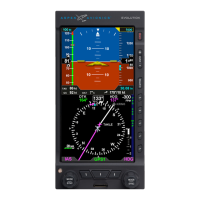
EFD1000 PFD Pilot’s Guide
CHAPTER 4, REFERENCE GUIDE
EFD1000 PFD Pilot’s Guide
EFD1000 PFD Pilot’s Guide Page 4-51A-01-184-00 REV B
“APPR” Mode Operation – GPS or GPS/RNAV APV WAAS Approach
1. With a valid GPS approach programmed in the GPS, use the CDI Nav Source
Select button to couple the GPS to the CDI (Section 4.3.5).
2. If Auto Course Select is disabled, set the Course Pointer to the desired course
(Section 4.3.7), or enable Auto Course Select (Section 4.3.6).
3. With GPSS disabled, set the EFD1000 heading bug to a value that will
intercept the active leg of the ight plan (Section 4.3.9) or enable GPSS via
the GPSS Hot Key.
4. Once established inbound to the Final Approach Fix (FAF), engage the
autopilot’s NAV or APPR mode.
5. Engage the autopilot in HDG mode and verify that the aircraft turns to a
heading to intercept the active leg of the approach.
6. Monitor the CDI cross track deviation and verify that, upon intercepting the
active leg of the approach, the autopilot turns to track the GPS approach
guidance
THE FOLLOWING APPLIES FOR WAAS GPS/RNAV APV APPROACHES ONLY
7. Once cleared for the GPS/RNAV approach, arm the autopilot’s APPR mode.
8. Monitor the CDI lateral deviation and verify that, while tracking and/or
intercepting the nal approach course and once the GPS APPR mode goes
active and vertical deviation is presented on the EFD1000’s VDI, the autopilot
arms the glide slope.
9. Most WAAS GPS will not arm or activate vertical guidance until the aircraft is
within two miles of the FAF (unlike an ILS where the VDI will display as soon as
the aircraft is established in-bound and a valid GS signal is being received). As
you approach the FAF, watch for the VDI to appear on the EFD1000’s Attitude
Display, indicating that the autopilot will likely couple to that glide slope.
9. Monitor the autopilot lateral approach course tracking. Upon intercepting
the WAAS glide slope, verify that the autopilot switches from glide slope ARM
to glide slope capture, and initiates a descent to track the WASS glide slope.
NOTE
WAAS GPS systems can provide vertical
guidance on several types of GPS/RNAV
instrument approaches. RNAV (GPS) APV
(Approaches with Vertical Guidance), such
as LPV and LNAV/VNAV approaches, often
have lower approach minima shown on
the approach plate, and aircraft equipped
with appropriate WAAS GPS systems may
use those lower minima.
Even with more traditional lateral-
guidance-only RNAV (GPS) approaches
— (LNAV) with step-down altitudes
— WAAS GPS systems may still provide
a pseudo-glide slope that enables a
continuous descent to the MDA (Minimum
Descent Altitude) and that will couple to
the autopilot GS.
All these types of approaches are set up
and own the same way by the pilot
and autopilot, and operate much like an
ILS approach. The pilot must be aware
of the dierences and which minima
may be used, however. Especially in
LNAV approaches with advisory vertical
guidance, the pilot is still responsible for
complying with all interim step-down
altitudes and with the MDA.


 To Next Page