CHAPTER 2, CONTROLS AND DISPLAY
EFD1000 PFD Pilot’s Guide
Page 2-20 A-01-184-00 REV B
EFD1000 PFD Pilot’s Guide
EFD1000 PFD Pilot’s Guide
2.3.1. Attitude Display
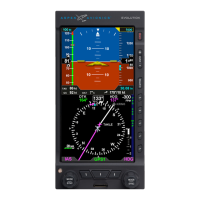
The Attitude Display includes an Attitude Director Indicator (ADI) with single-cue Flight
Director command V-bars (when connected to a compatible autopilot), an Airspeed
tape, an Altimeter tape, an Altitude Alerter (with separate minimums alerting), and
Instrument Approach indicators (Table 2-6 and Figure 2-27). For more details on
each, see the Reference Guide, Chapter 4.
The Airspeed and Altitude tapes are the most obvious dierences from a mechanical
ADI. These tapes are common on most EFIS PFDs, and will be immediately familiar to
pilots with EFIS experience. Pilots without prior EFIS experience may need some time,
experience, and training to get comfortable using the Airspeed and Altimeter tapes as
their primary references.
In single-tube EFD1000 PFD installations, where the mechanical airspeed indicator
and altimeter remain in their original locations, transitioning pilots can use either their
familiar mechanical instruments or the PFD tapes for airspeed and altitude references.
Many pilots new to EFIS quickly nd themselves relying on the tapes within just a
ight or two. If the tapes prove distracting at any time, however, the pilot can remove
them from the display by pressing the TPS Hot Key (Figure 2-2 No. 66, single-tube
installations only).


 To Next Page