CHAPTER 4, REFERENCE GUIDE
EFD1000 PFD Pilot’s Guide
Page 4-32 A-01-184-00 REV B
EFD1000 PFD Pilot’s Guide
EFD1000 PFD Pilot’s Guide
The bearing pointers indicate only the bearing information provided by their selected
navigation sources. They resemble and perform like traditional Radio Magnetic
Indicator (RMI) needles. Each bearing pointer’s head and tail is aligned with the
corresponding bearing/radial value on the compass. The pilot can select a navigation
source for each of the bearing pointers from the same VOR and GPS sources available to
the CDI or simply turn the bearing pointer, source information, and source legend OFF.
Each bearing pointer is associated with a button, selected source name label, and
information block. The button immediately to the left of the CDI source selection
button is associated with and controls the Single-Line Bearing Pointer. Likewise, the
button immediately to the right of the CDI source selection button is associated with
and controls the Double-Line Bearing Pointer. The bearing pointers’ source names and
information blocks are shown directly above their respective buttons.
Unlike the CDI which can be adjusted by the pilot, no adjustments can be made to the
bearing pointers. When a VOR is selected as a bearing pointer source, the arrow of the
needle indicates the direction to the VOR navaid to which the receiver is tuned. The
position of the bearing pointer tail, with respect to the compass, indicates the aircraft’s
current position on the VOR radial. When a GPS source is selected, the bearing pointer
indicates the bearing to the active waypoint.
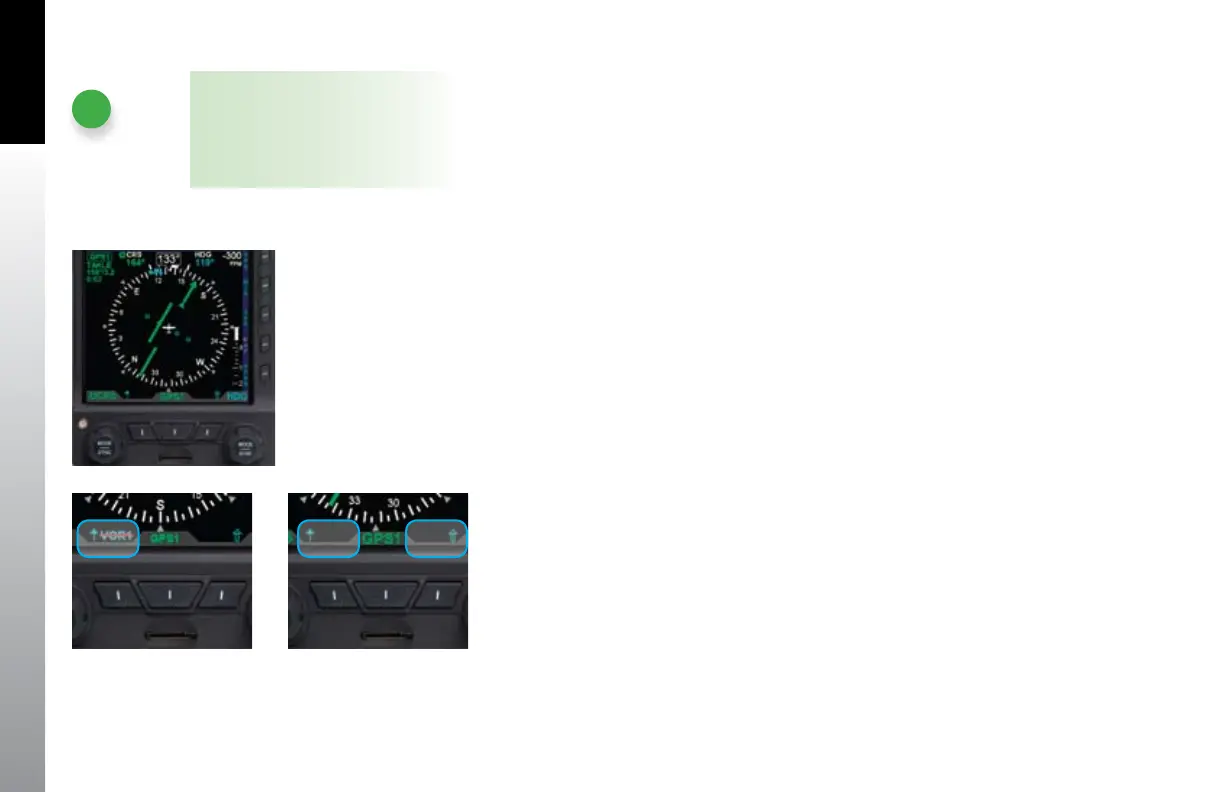
When the bearing pointer source data is not available or invalid, the bearing pointer
and source information are removed (Figure 4-70) and the bearing pointer source
legend is slashed with a red line (Figure 4-71).
When a bearing pointer is turned OFF, the legend shows the bearing pointer icon, but
the selected source, the source information eld, and the bearing pointer are removed
(Figure 4-72).
NOTE
A VOR that is tuned to a localizer
frequency shall be considered an
invalid bearing pointer source since
Localizer signals provide no bearing
information.
Figure 4-72
Bearing Pointers OFF
Figure 4-70
NO bearing pointers or
source information
Figure 4-71
Invalid Bearing Pointer
Source Data Label


 To Next Page