CHAPTER 3, FLYING THE EFD1000 PRO PFD
EFD1000 PFD Pilot’s Guide
Page 3-6 A-01-184-00 REV B
EFD1000 PFD Pilot’s Guide
EFD1000 PFD Pilot’s Guide
NOTE
Start-up times for the EFD1000 are highly dependent on aircraft
temperature. In extremely cold weather, when the aircraft has gotten
cold soaked overnight, it may take several minutes (usually no more than
ve) for the PFD to be fully operational. On the second or third ight
of the day, and/or on very hot days, the PFD may come up within 30
seconds or less.
After engine start, turn the Avionics Master ON. Until the navigation radios are
operational, the nav source annunciations on the EFD1000 will be shown with a red
line slashed through them (Figure 3-4), and the GPS1, GPS2 and INTEG cautions will
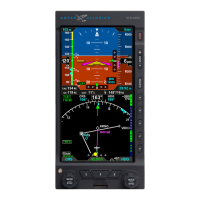
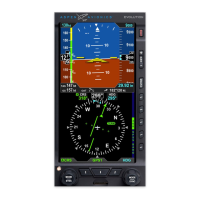
be annunciated on the left edge of the display (Figure 3-5 and 3-6). The CDI Source
Select will default to VLOC1. Once the nav radios have warmed up, the red slash will be
removed from the CDI Source annunciation.
NOTE
GPS will not output valid navigation information until programmed
with an active ight plan or direct-to waypoint, and thus will be agged
on the EFD1000 and cannot be selected as a CDI or Bearing Pointer
navigation source until they are programmed with an active waypoint.
Once the radios are available, we pick up the ATIS, and learn that the local altimeter
setting is 30.15, and that Runway 8 is in use for departures.
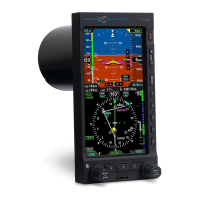
Figure 3-4
CDI Source Slashed Invalid
Figure 3-5
GPS1 Shown Flagged
Figure 3-6
GPS2 Shown Flagged
NOTE
Whenever there is a new altimeter
setting, be certain to set both the
EFD1000 PFD and the mechanical
standby altimeter.


 To Next Page