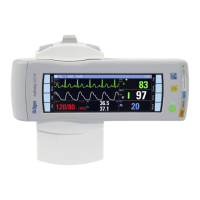
ECG, arrhythmia, and ST segment monitoring with M300
150 Instructions for use – Infinity
®
M300 and M300+ series – VG3.0
– Paced pulses of 0.2 – 0.5ms and amplitude voltage from -2.0 – 700 mV with overshoot greater than
0.3% may result in missed valid heart beats, contributing to a lower than actual heart rate.
Dräger recommends closely monitoring paced patients.
False high-rate alarms can result under the following conditions:
– Asynchronous pacemaker with large pace pulse tails and at low heart rate (30 bpm)
– Pace pulses above 200 - 700 mV, such as when an external pacemaker is used, may cause an
electrical overshoot which can mimic a QRS complex, which may affect the accuracy of ECG beat
classification.
Dräger recommends monitoring transcutaneous paced patients in accordance with your hospital's policy.
– With lower pace pulses of -2.0 - 2.0 mV an electrical overshoot can occur, and mimic a QRS com-
plex, which may affect the accuracy of ECG beat classification.
– Large atrial pacemaker pulse followed by a large ventricular pacemaker pulse (both having identi-
cal amplitude and durations)
Dräger recommends closely monitoring paced patients.
NOTE
The displayed heart rate may be incorrect if the pacemaker pulse wanders through the ECG waveform
(ineffective pacing). During the wandering pacemaker test required by IEC 60601-2-27 and ANSI/AAMI
EC13, the displayed heart rate varied between 15 and 30 bpm (rather than consistently being 30 bpm).
WARNING
Make sure that pacer detection is turned OFF for patients without pacemakers. Make sure that it
is ON for patients with pacemakers. Deactivating pacer detection for paced patients may result
in pacemaker pulses being counted as regular QRS complexes, which could prevent an asystole
alarm from being detected. Always verify that the pacer detection status is correct for the patient.
WARNING
Interference from a monitor may cause some rate-adaptive implantable pacemakers to pace at
unnecessarily high rates. Be extra vigilant with patients when using these types of pacemakers.
WARNING
Always keep pacemaker patients under close surveillance and monitor their vital signs carefully.
– Do not assess the patient’s condition exclusively from the heart rate values the monitor dis-
plays and the rate alarms that are generated. Heart rate meters may continue to count the
pacemaker rate during cardiac arrest or some arrhythmias.
– Some pacemakers (especially external pacemakers with body surface electrodes) emit pulses
with amplitudes far exceeding the 700 mV maximum amplitude specified for the M300. The
M300 may incorrectly detect these large pacemaker pulses as valid QRS complexes and may
fail to detect cardiac arrest.


 To Next Page
 Loading...