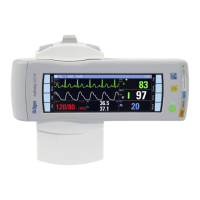
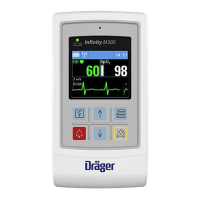
ECG, arrhythmia, and ST segment monitoring with M300
152 Instructions for use – Infinity
®
M300 and M300+ series – VG3.0
– Transcutaneous
electrical nerve stimulators
Signals from transcutaneous electrical nerve stimulators (TENS) often resemble pacemaker signals
and can be labeled as such. The M300 can reject valid QRS complexes, which follow misinterpreted
TENS signals. If TENS signals continue to register as pacer spikes, disable pacer detection (see page
148).
Overview of arrhythmia monitoring
The M300 performs arrhythmia (ARR) monitoring on adult and pediatric patients. The selected arrhythmia
mode controls which arrhythmia parameters are monitored (see page 157).
The arrhythmia monitoring functions are configurable in the arrhythmia setup page (see page 159).
Before performing any monitoring functions, refer to the section "For your safety and that of your patients"
on page 7.
WARNING
When HR alarm limits and ARR monitoring are disabled, the monitor cannot report asystole
(ASY) and ventricular fibrillation (VF) alarms. To enable ASY and VF alarms, always keep HR
alarm limits enabled.
NOTE
The HR alarms off banner appears in the header bar of the BedView and viewport when heart rate alarm
limits are disabled and arrhythmia monitoring is enabled.
The HR,ASY,VF off banner appears in the header bar of the BedView and viewport when heart rate alarm
limits are disabled and arrhythmia monitoring is disabled.
NOTE
For all non-arrhythmia alarms, events other than Arrhythmia are saved only if the event is set to Store
and an alarm is turned on and generated.


 To Next Page
 Loading...