Proline Promass E 500 PROFIBUS PA Installation
Endress+Hauser 25
6.1.2 Environmental and process requirements
Ambient temperature range
Measuring device • –40 to +60 °C (–40 to +140 °F)
• Order code for "Test, certificate", option JP:
–50 to +60 °C (–58 to +140 °F)
Readability of the local
display
–20 to +60 °C (–4 to +140 °F)
The readability of the display may be impaired at temperatures outside the
temperature range.
Dependency of ambient temperature on medium temperature → 279
‣
If operating outdoors:
Avoid direct sunlight, particularly in warm climatic regions.
Static pressure
It is important that cavitation does not occur, or that gases entrained in the liquids do not
outgas.
Cavitation is caused if the pressure drops below the vapor pressure:
• In liquids that have a low boiling point (e.g. hydrocarbons, solvents, liquefied gases)
• In suction lines
‣
Ensure the static pressure is sufficiently high to prevent cavitation and outgassing.
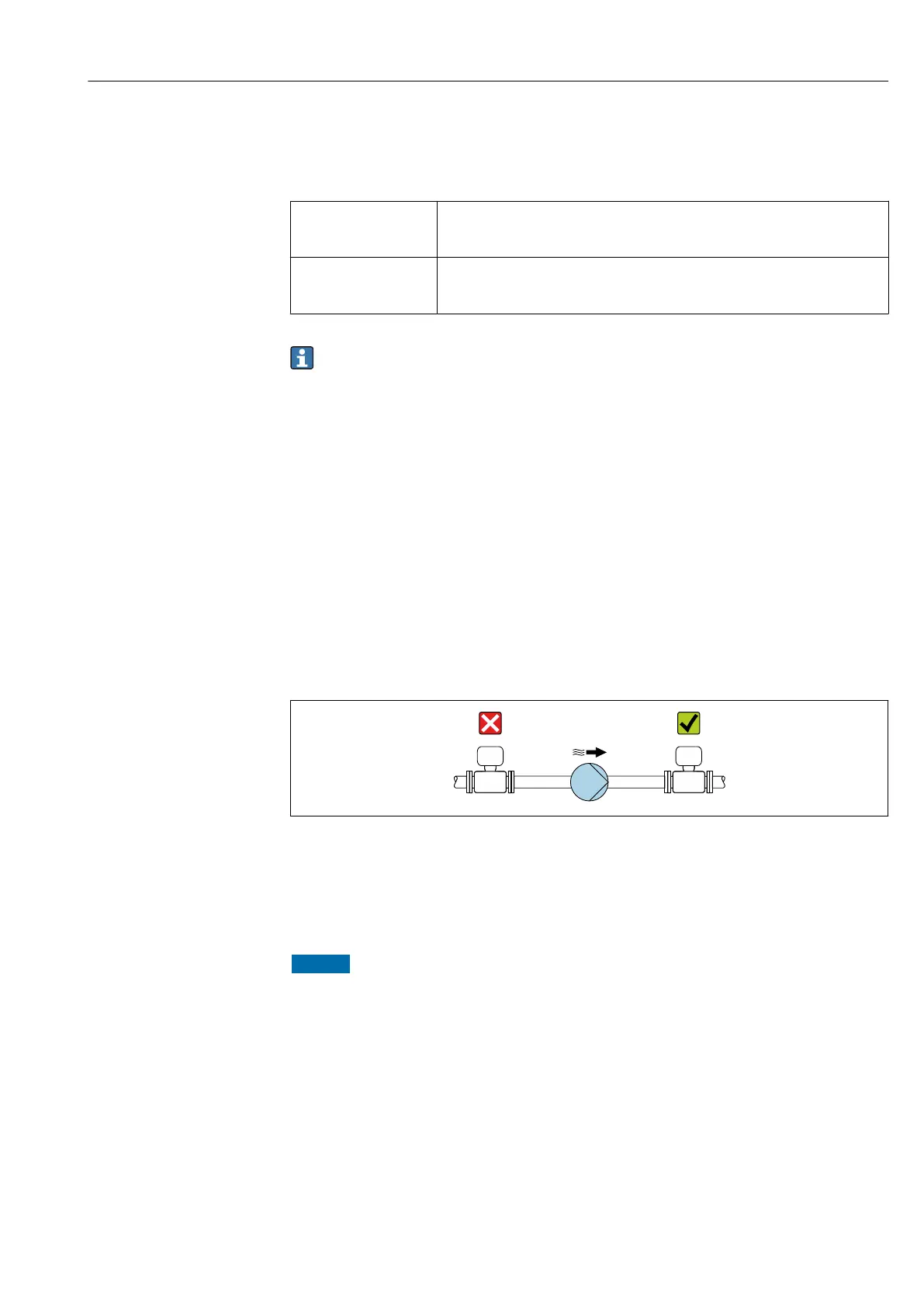
For this reason, the following mounting locations are recommended:
• At the lowest point in a vertical pipe
• Downstream from pumps (no danger of vacuum)
A0028777
Thermal insulation
In the case of some fluids, it is important to keep the heat radiated from the sensor to the
transmitter to a low level. A wide range of materials can be used for the required
insulation.
NOTICE
Electronics overheating on account of thermal insulation!
‣
Recommended orientation: horizontal orientation, sensor connection housing pointing
downwards.
‣
Do not insulate the sensor connection housing.
‣
Maximum permissible temperature at the lower end of the sensor connection housing:
80 °C (176 °F)
‣
Regarding thermal insulation with an exposed extended neck: We advise against
insulating the extended neck to ensure optimal heat dissipation.








 To Next Page