introduced the word “glitching” to the pro-audio vocabulary. The H949 was the world’s first de-glitched
Harmonizer. Unlike the Diatonic pitch shifters, pitch shifting is in the feedback loop allowing for
arpeggiated repeats.
Note
For the purists in our audience, you may remember that the H910 and H949 were mono in, stereo
out devices. In other words, they featured a single pitch shifter with independently adjusted delays.
To best emulate these vintage boxes, we recommend that you set either Pitch A or Pitch B to unison
(1.00) and use that output for feedback without pitch change.
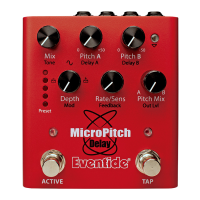
Mix: Wet/dry mixer, 100% is all wet signal.
Pitch A/Pitch B Mix: Controls the ratio of the level of Pitch A to Pitch B.
Pitch Shift Up A: Controls the amount of pitch shift for voice A expressed as a ratio.
Pitch Shift Down B: Controls the amount of pitch shift for voice B expressed as a ratio.
Delay A: Controls the amount of time delay of the A pitch-shifted output. With Tempo Sync OFF,
delay is displayed in ms. With Tempo Sync ON, delay can be sync’d to the tempo and is displayed as
a rhythmic sub-division of the tempo beat value.
Delay B: Controls the amount of time delay of the B pitch-shifted output. With Tempo Sync OFF,
delay is displayed in ms. With Tempo Sync ON, delay can be sync’d to the tempo and is displayed as
a rhythmic sub-division of the tempo beat value.
Splice Type: Selects the type of Harmonizer emulated:
H910: The H910 was just a tiny bit unstable. And it showed. The H910’s iconic, flickering
display was the first ‘digital readout’ to appear in many studios. And that flickering readout belied
a secret – the H910 was inherently ‘jittery’. The H910’s master clock wasn’t crystal-based but,
instead, it was a tuned LC (inductor/capacitor) oscillator. The result is that the system was not
locked to a specific frequency and the entire system’s clocking would drift slightly, slowly and
unpredictably. In fact, all of the oscillators in the H910 are of the ‘free-running’ sort and this
randomness adds to the sound (and the fun). This Algorithm’s pitch change splicing method is the
same as the hardware’s – the glitch is back!
H949-1: Algorithm 1 may cause glitches with increasing frequency as the pitch ratio deviates
from 1:1, and is generally more appropriate for smaller pitch ratios.
•
•
•
•
•
•
•
•
•
11. ALGORITHM GUIDE




 To Next Page