Chapter 7 Wireless 103
WPA-PSK, WPA2-PSK, and Mixed WPA/WPA2-PSK
They belong to pre-shared key or personal key modes, where Mixed WPA/WPA2-PSK supports
both WPA-PSK and WPA2-PSK.
WPA-PSK, WPA2-PSK, and Mixed WPA/WPA2-PSK adopt a pre-shared key for authentication,
while the CPE generates another key for data encryption. This prevents the vulnerability
caused by static WEP keys, and makes the three security modes suitable for ensuring security
of home wireless networks.
Nevertheless, because the initial pre-shared key for authentication is manually set and all
clients use the same key to connect to the same CPE, the key may be disclosed unexpectedly.
This makes the security modes not suitable for scenarios where high security is required.
To address the key management weakness of WPA-PSK and WPA2-PSK, the WiFi Alliance puts
forward WPA and WPA2, which use 802.1x to authenticate clients and generate data
encryption–oriented root keys. WPA and WPA2 use the root keys to replace the pre-shared
keys that set manually, but adopt the same encryption process as WPA-PSK and WPA2-PSK.
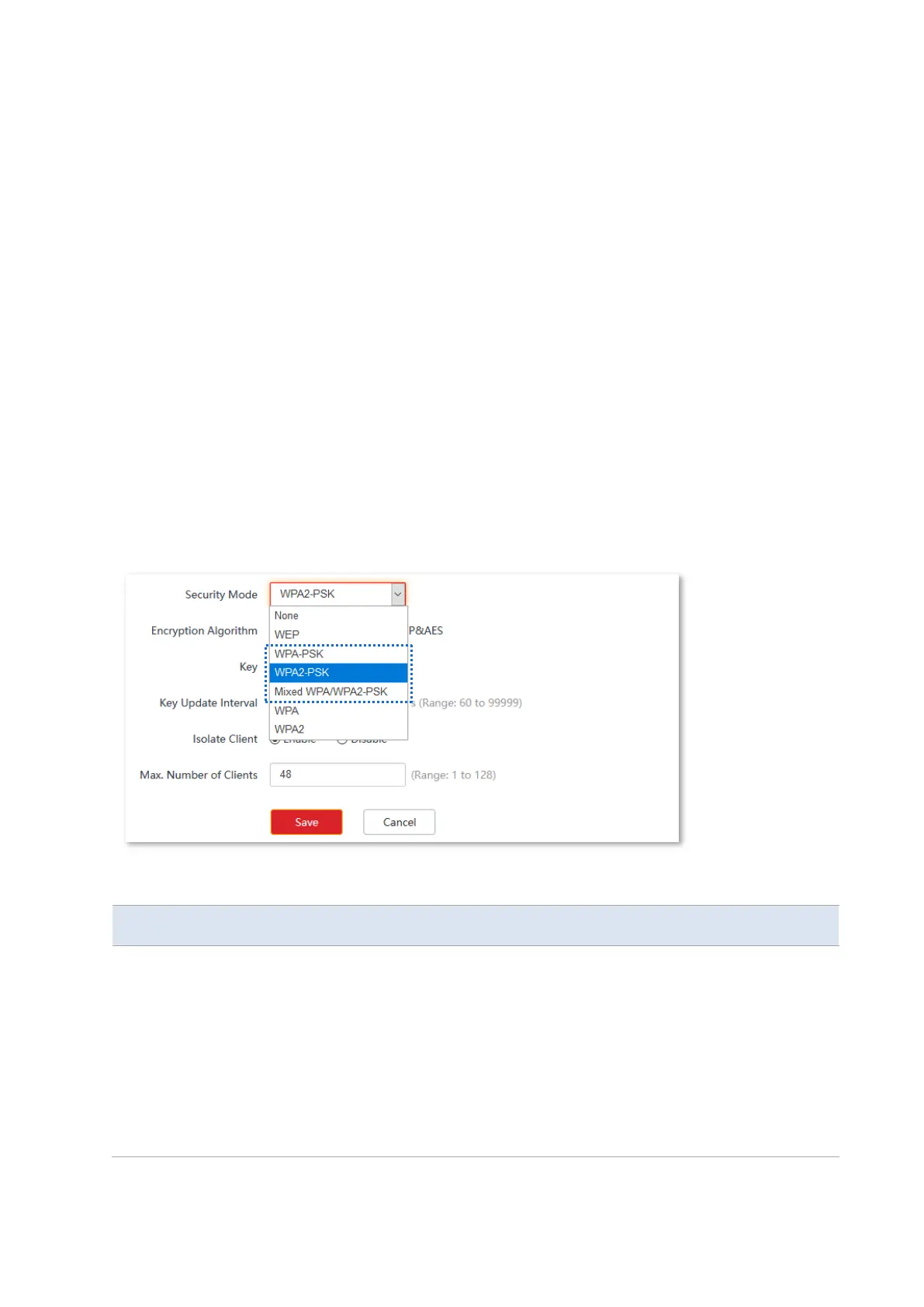
When the security mode is set to WPA-PSK, WPA2-PSK, or Mixed WPA/WPA2-PSK, the page is
shown as follows.
Parameters description
It indicates the personal or pre-shared key security mode, including WPA-PSK,
WPA2-PSK, and Mixed WPA/WPA2-PSK.
−
WPA-PSK: It indicates that the wireless network corresponding to the
selected SSID is encrypted using WPA-PSK.
−
WPA2-PSK: It indicates that the wireless network corresponding to the
selected SSID is encrypted using WPA2-PSK.
−
Mixed WPA/WPA2-PSK: It indicates that wireless clients can connect to
the wireless network corresponding to the selected SSID using either
WPA-PSK or WPA2-PSK.


 To Next Page