Chapter 7 Wireless 104
It specifies the encryption algorithm corresponding to the selected security
mode. If Security Mode is set to WPA-PSK, this parameter has the AES and TKIP
values. If Security Mode is set to WPA2-PSK or Mixed WPA/WPA2-PSK, this
parameter has the AES, TKIP, and TKIP&AES values.
−
AES: It indicates the Advanced Encryption Standard.
−
TKIP: It indicates the Temporal Key Integrity Protocol. If TKIP is used, the
maximum wireless throughput of the CPE is limited to 54 Mbps.
−
TKIP&AES: It indicates that both TKIP and AES encryption algorithms are
supported. Wireless clients can connect to the wireless network
corresponding to the selected SSID using TKIP or AES.
It specifies a pre-shared WPA key. A WPA key can contain 8 to 63 ASCII
characters or 8 to 64 hexadecimal characters.
It specifies the automatic update interval of a WPA key for data encryption. A
shorter interval results in higher data security.
The value 0 indicates that a WAP key is not updated.
WPA and WPA2
WPA and WPA2 uses 802.1x to authenticate clients and the login information of a client is
managed by the client. This effectively reduces the probability of information leakage.
In addition, each time a client connects to an AP that adopts the WPA or WPA2 security mode,
the RADIUS server generates a data encryption key and assigns it to the client. This makes it
difficult for attackers to obtain the key.
These features of WPA and WPA2 help significantly increase network security, making WPA
and WPA2 the preferred security modes of wireless networks that require high security.
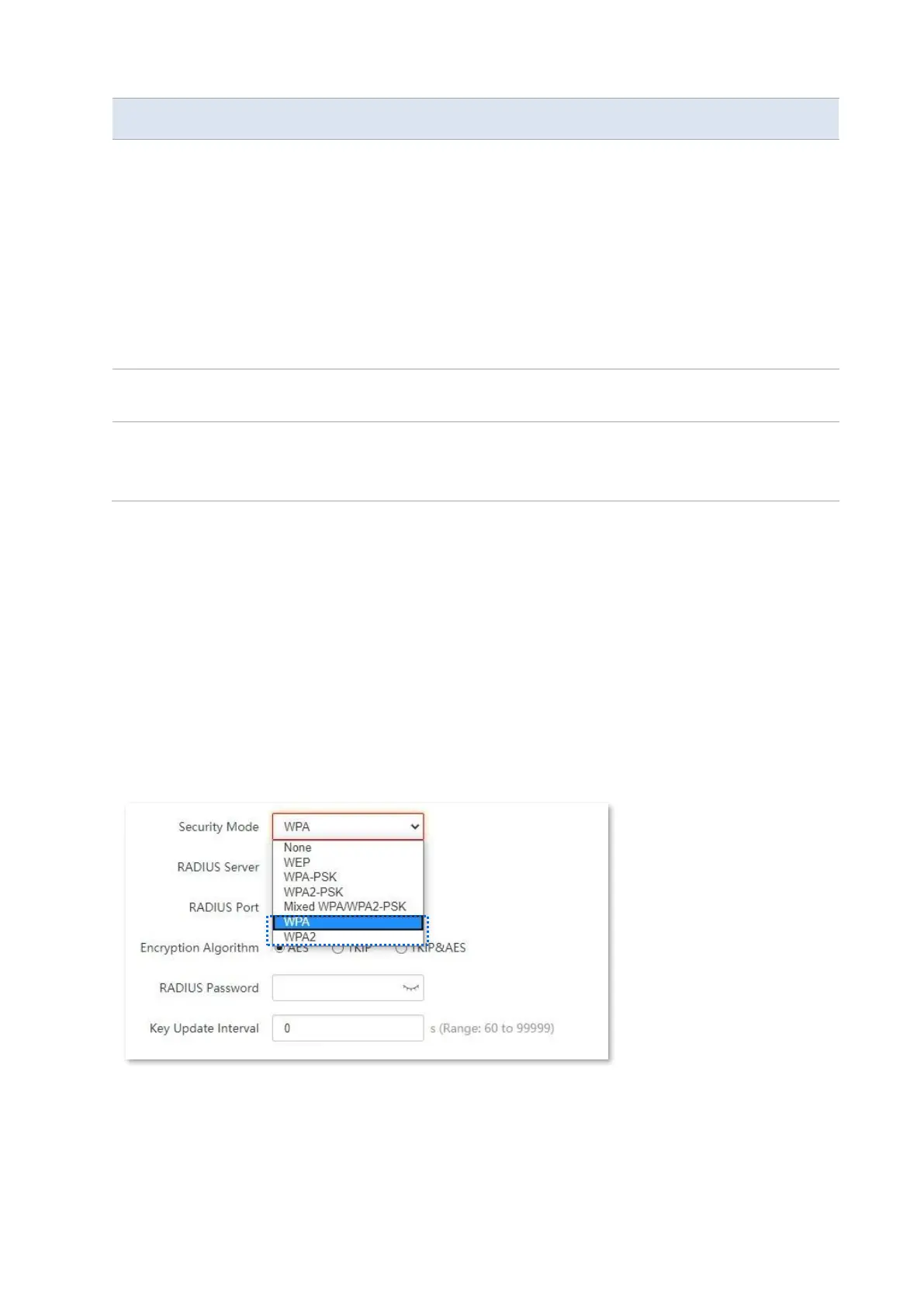
When the security mode is set to WPA or WPA2, the page is shown as follows.


 To Next Page